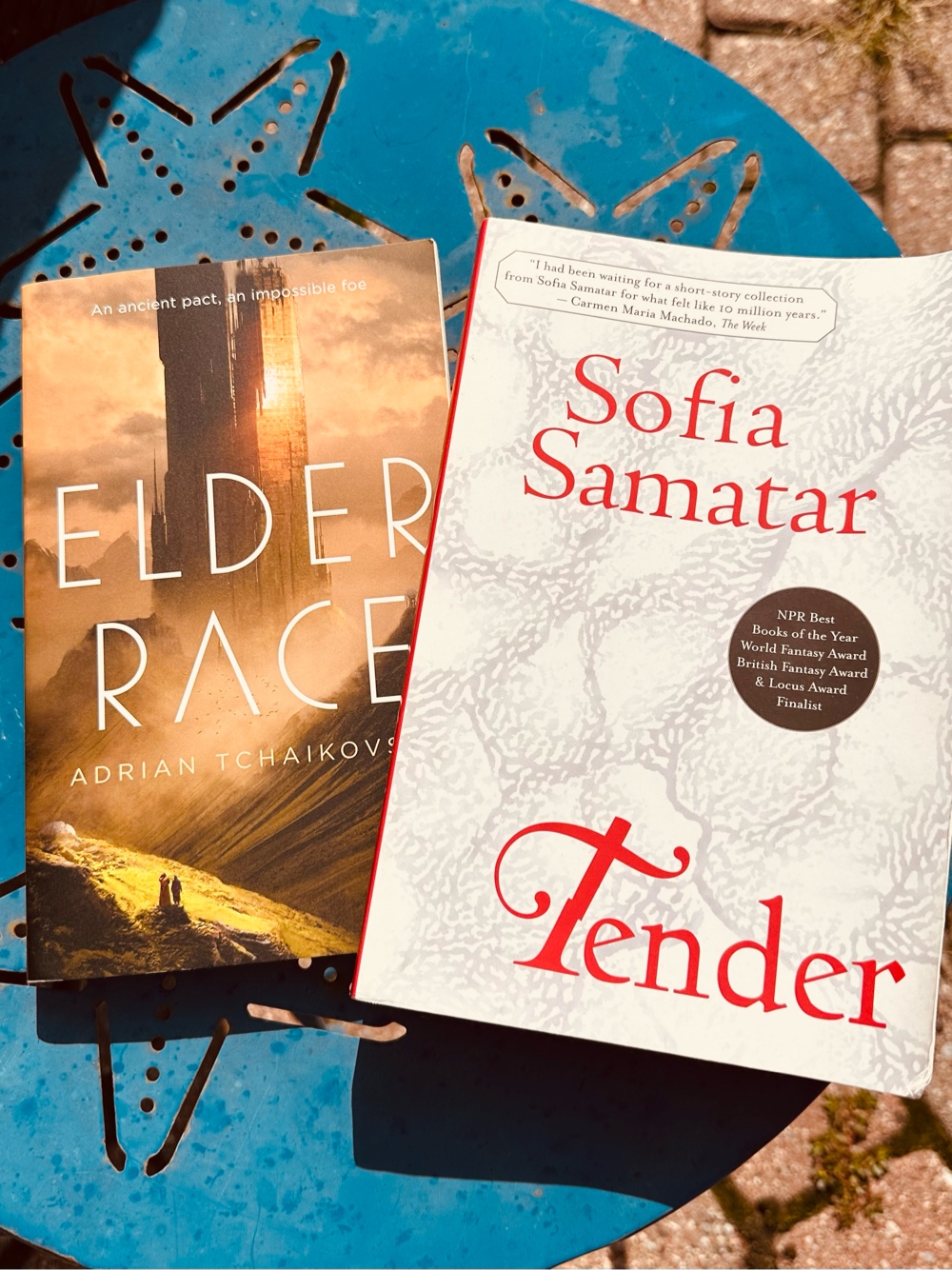
Tuesday, February 10, 2026

Books Read in 2025: The Five-Stars

I forgot to look at the author distribution of the book I read last year at the beginning of these. Out of 191 books, 131 were by women - fairly happy with that. 30 were by non-white authors - room for improvement there. 12 were by gay, trans or non-binary authors - a lot of room for improvement there. 2 were titled Audition, I just realized. I mentioned that a lot of them took place on trains. 

For next year I need to make a list of non-white non-cis-or-hetero authors and some kind of schedule for accountability. I have decided to take a break from mysteries - I've had a string of disappointing ones and it just feels like wasted reading time. Will avoid them for February and then only read ones by authors I already know I like or with reviews from publications I trust - no more scrolling the library ebooks and grabbing ones that sound good but might not be. I have a loose goal of trying to read books by African authors from countries I haven't read a lot from. I've read authors from Nigeria, Zambia, Morocco, Zimbabwe, Rwanda, Ethiopia, Egypt and wow, I have gone embarrassingly far back in my Goodreads list for those seven countries, which is a pretty lousy showing. I had a Bibliophile Diverse Spines calendar in 2024. I couldn't find one for the next year, but I did copy down all the titles in a notebook. Do I know precisely where in my chaotic house said notebook is at this present moment? Not exactly, but I can probably find it. 

Found it. Now to restrain myself from putting forty books on hold because I am trying to wind DOWN the Great Library Book Experiment of 2026 in favour of reading the books on my Kindle and physical bookshelf that have been regarding me plaintively as I mow through the towering triple stack of library books on the table at the foot of my bed. 

These were my favourite reads from last year. I'm always aware that the point of life I'm at and the mood I'm in absolutely influence how I receive a book, so while I'm prepared to swear that they are all well-written and entertaining, I have no idea where they will fall on the amazing scale for other readers. I scanned the list to see if I could pick one that, gun to my head, I would call my favourite book of the year. I think I've settled on Once Was Willem, but everything else was tied for 1.01 place. I am not separating them by genre, this is just a book soup. 

FIVE STARS *****

The Girl Who Drank the Moon by Kelly Barnhill: Synopsis from Goodreads: Every year, the people of the Protectorate leave a baby as an offering to the witch who lives in the forest. They hope this sacrifice will keep her from terrorizing their town. But the witch in the forest, Xan, is kind and gentle. She shares her home with a wise Swamp Monster named Glerk and a Perfectly Tiny Dragon, Fyrian. Xan rescues the abandoned children and deliver them to welcoming families on the other side of the forest, nourishing the babies with starlight on the journey. 

One year, Xan accidentally feeds a baby moonlight instead of starlight, filling the ordinary child with extraordinary magic. Xan decides she must raise this enmagicked girl, whom she calls Luna, as her own. To keep young Luna safe from her own unwieldy power, Xan locks her magic deep inside her. When Luna approaches her thirteenth birthday, her magic begins to emerge on schedule--but Xan is far away. Meanwhile, a young man from the Protectorate is determined to free his people by killing the witch. Soon, it is up to Luna to protect those who have protected her--even if it means the end of the loving, safe world she’s always known.

-"'But he didn’t kill the witch. The Witch killed him instead.

This is why it doesn’t pay to be brave. Bravery makes nothing, protects nothing, results in nothing. It only makes you dead. And this is why we don’t stand up to the Witch. Because even a powerful old wizard was no match for her.'" I already told you this story is true. I only tell true stories. Now. Off with you, and don’t let me catch you shirking on your chores. I might send you to the Witch and have her deal with you.

Swiped from one of my libraries for a couple of days based solely on the beautiful cover (and a long-ago mostly-abandoned vow to read and review all the Newbery Medal books). Was immediately smitten. I loved how the corruption of the rulers of the town was immediately set down ("that baby isn't going to sacrifice itself!"), and the kindness of the witch as well. This read like an instant classic to me - the strong, kind personalities of the witch and the swamp monster and Antain and Ethyne, the endless torment and rage of the woman who loses her baby and refuses to buy into the uneasy bargain struck by the townspeople. The author isn't afraid to go dark in a children's book, which I always appreciated as a child. I loved this. I immediately bought my own copy, which Eve immediately stole when she got home and spirited away to Hamilton, so I will have to buy another one. 

Dead Woman Walking by Sharon Bolton: Synopsis from Goodreads: Just before dawn in the hills near the Scottish border, a man murders a young woman. At the same time, a hot-air balloon crashes out of the sky. There’s just one survivor.

She’s seen the killer’s face – but he’s also seen hers. And he won’t rest until he’s eliminated the only witness to his crime.

Alone, scared, trusting no one, she’s running to where she feels safe – but it could be the most dangerous place of all.

"'We don’t watch American sitcoms any more at recreation, we search for documentaries about organ trafficking. Sister Serapsis wanted chapter and verse on how much various organs cost on the black market and actually argued with me for ten minutes that a liver should be worth more than heart because a liver clears the body of all the ill humours. Sister Alfreda has offered her kidney to pay for repairs to the chapel roof and Sister Tabitha insists I tell you that you have to – her words now – stake out Whitby because there’s always been something dodgy about Whitby since Dracula landed.’ Jessica sat back down on the bench. ‘I’m living in a budget sequel to Sister Act.’”

Holy crap, it's been a while since I read something that landed so squarely the way I needed it to. I've been having trouble sleeping so was ready to just commit to something that wouldn't finish until past 3 a.m., and this was just the thing. I read a lot of mysteries, and I am well versed in common tropes and techniques and telegraphed twists, and this completely took me by surprise. Perfectly measured and paced. I was in actual suspense, and there were also perfectly-pitched moments of hilarity. This author can be hit or miss for me, but I always take a crack at each book because the wins are big.

Several People are Typing by Calvin Kasulke: Synopsis from Goodreads: A work-from-home comedy where WFH meets WTF.

Told entirely through clever and captivating Slack messages, this irresistible, relatable satire of both virtual work and contemporary life is The Office for a new world.

Gerald, a mid-level employee of a New York–based public relations firm has been uploaded into the company’s internal Slack channels—at least his consciousness has. His colleagues assume it’s an elaborate gag to exploit the new work-from home policy, but now that Gerald’s productivity is through the roof, his bosses are only too happy to let him work from . . . wherever he says he is.

Faced with the looming abyss of a disembodied life online, Gerald enlists his co-worker Pradeep to help him escape, and to find out what happened to his body. But the longer Gerald stays in the void, the more alluring and absurd his reality becomes.

Meanwhile, Gerald’s colleagues have PR catastrophes of their own to handle in the real world. Their biggest client, a high-end dog food company, is in the midst of recalling a bad batch of food that’s allegedly poisoning Pomeranians nationwide. And their CEO suspects someone is sabotaging his office furniture. And if Gerald gets to work from home all the time, why can’t everyone? Is true love possible between two people, when one is just a line of text in an app? And what in the hell does the :dusty-stick: emoji mean?


In a time when office paranoia and politics have followed us home, Calvin Kasulke is here to capture the surprising, absurd, and fully-relatable factors attacking our collective sanity…and give us hope that we can still find a human connection.

gerald

It’s just like

All the time, everywhere, on here

You can just scroll and scroll and it won’t stop until you do

We call it ephemera

Or at least I did, before, I called it ephemera and really that’s a mistake, it cheapens it

We love to say the digital is fleeting

Like a sunset

But these scraps of ourselves we fling into the ether will outlive most of us, like the sun

All this is to say

I figured out how to read everyone’s private Slack messages from inside here

The messages of everyone at the company, anyway

And it’s just like

*whew*

You  know?”

It's entirely possible - likely, even - that I am rating this so highly because it is the first of its kind that I've read. I'm comfortable with that - he got in early, he deserves the reap the benefits. This was a fast, exhilarating read outside on a fall day, partly because it is short and propulsive due to its form and partly because I could not stop reading. It's a heady blend of odd, funny, melancholy and terrifying, with aching moments of human connection, outright slapstick, and a brilliant deployment of The Second Coming by W.B. Yeats.

Greenteeth by Molly O'Neill: Synopsis from Goodreads: From an outstanding new voice in cozy fantasy comes Greenteeth, a  tale of fae, folklore, and found family, narrated by a charismatic lake-dwelling monster with a voice unlike any other, perfect for fans of T. Kingfisher.

Beneath the still surface of a lake lurks a monster with needle sharp teeth. Hungry and ready to pounce.

Jenny Greenteeth has never spoken to a human before, but when a witch is thrown into her lake, something makes Jenny decide she's worth saving. Temperance doesn't know why her village has suddenly turned against her, only that it has something to do with the malevolent new pastor.

Though they have nothing in common, these two must band together on a magical quest to defeat the evil that threatens Jenny's lake and Temperance's family, as well as the very soul of Britain.

-”The witch looked surprised to see me, her eyes blinking furiously at me through murky waters. I don’t know why she was so astonished. It was my lake she’d been thrown into; she should have expected I’d come and see if there was anyone worth eating.”


-”There was nothing in that smile, it was as empty as a carved jack-o’lantern. His eyes were the same: dead, devoid of emotion, of fear, of pleasure. There was only a yawning hunger behind them. This was not a creature that would be satisfied with the flesh of humans. It could devour the very soul of the world and feel nothing but a desire for more. There was intelligence, yes, but focused on that single goal; filling that emptiness, that gaping void.”

I don't know if it's age or having come through Covid times or *gestures broadly at everything*, but I used to have no interest in the cozy, either mystery or fantasy variety, and I have become a much bigger fan recently. This was so lovely, and quietly feminist, and well-written - I love a positive witch story, and this was also a Jenny Greenteeth rehabilitation, and a found-family tale, and an epic quest, and a 'bargain with the faeries and hope you survive' story, and a story about complicated friendships, and I loved it.

Once Was Willem by M.R. Carey: Synopsis from Goodreads: From the bestselling author M. R. Carey comes an utterly unique and enchantingly dark epic fantasy fable like no other.

This is the tale of Once Was Willem, who - eleven hundred and some years after the death of Christ, in the kingdom that had but recently begun to call itself England - rose from the dead to defeat a great evil facing the humble village of Cosham.

Pennick for all its beauty was ever a place with a dark reputation. The forests of the Chase were said to be home to nixies and boggarts, and there was a common belief, passed down through many generations, that the castle housed an unquiet ghost of terrible and malign power. These rumours I can attest were all true; indeed they fell short of the truth by a long way . . .

-”Marlie Scour…She was Cosham’s midwife and also its healer, and as is ever the way with such women, whenever she was not being desperately sought after for her skills, she was being whispered against as a witch.”

-”Cain Caradoc was then two hundred years old. If he seemed younger it was because he had found ways of gleaning youth from the places where it was most readily to be found, which is to say the young. All his care was to prolong his life for as long as might be managed, and so to put off indefinitely a conversation with his maker that he feared might be irksome and unpleasant.”

M.R. Carey wrote one of my favourite (trope deleted because it's better if you don't know what it is going in, if at all possible) books ever (The Girl With All the Gifts). Nothing he's written since then has quite given me that same feeling of breathless, delighted admiration and enchantment until this.

It has classic, archetypal devices - be careful what you wish for, especially if what you wish for is a dead loved one to return, absolute power corrupts absolutely - but deploys them in a way that feels completely fresh. I love the stately, formal language that lends itself perfectly to the darkest horrors and occasionally surprising humour (that you sometimes have to stop a minute to process before realizing). The found family through-line is wonderful (clearly I am a devotee of the found-family trope, and I feel bound to declare that it is not because I have any complaint at all about my family-by-blood.) I loved this more than I expected to.

We Lived on the Horizon by Erika Swyler: Synopsis from Goodreads: A novel about a bio-prosthetic surgeon and her personal AI as they are drawn into a catastrophic war.

The city of Bulwark is aptly a walled city built to protect and preserve the people who managed to survive a series of great cataclysms, Bulwark was founded on a system where sacrifice is rewarded by the AI that runs the city. Over generations, an elite class has evolved from the descendants of those who gave up the most to found mankind’s last stronghold, called the Sainted.

Saint Enita Malovis, long accustomed to luxury, feels the end of her life and decades of work as a bio-prosthetist approaching. The lone practitioner of her art, Enita is determined to preserve her legacy and decides to create a physical being, called Nix, filled with her knowledge and experience. In the midst of her project, a fellow Sainted is brutally murdered and the city AI inexplicably erases the event from its data. Soon, Enita and Nix are drawn into the growing war that could change everything between Bulwark’s hidden underclass and the programs that impose and maintain order.

A complex, imaginative, and unforgettable novel, We Lived on the Horizon grapples with concepts as varied as the human desire for utopia, body horror, and what the future holds for humanity and machine alike.

-”’If the argument is that you’re not all terrible, that’s understood, but also somewhat meaningless,’ T. said. ‘Your assistant will understand. When there’s erroneous code it needs to be corrected, edited. Far more people have been harmed under the system as it is than have thrived under it.’ T. leaned against the wall farthest from her. There was a forced casualness to his stance, portraying calm rather than inhabiting it.

‘You’re not sure about all the killing though, are you?’ she said.

‘No. But too much ease is a kind of harm too. Plenty of you are rotted from the inside.’”

This was really beautiful - thoughtful, insightful, compassionate and bittersweet. The structure of the society, including the Sainted, sounds logical on the surface, but really just ends up setting up another society rooted in structural inequality, which inevitably leads to resentment and upheaval. The patient teasing out of the various lines of thinking, the ways people try to do good and sometimes fail, reminded me of Ursula K. LeGuin (The Dispossessed in particular). Different kinds of love and connection are also explored, in ways both moving and sorrowful. My second read by this prodigiously imaginative author, who brings to bear an intelligence that reads as both shrewd and benevolent.

The Buffalo Hunter Hunter by Stephen Graham Jones: Synopsis from Goodreads: From the New York Times bestselling author of The Only Good Indians comes a tale of the American West, writ in blood.

This chilling historical novel is set in the nascent days of the state of Montana, following a Blackfeet Indian named Good Stab as he haunts the fields of the Blackfeet Nation looking for justice.

It begins when a diary written in 1912 by a Lutheran pastor is discovered within a wall in 2012. What is unveiled is a slow massacre, a nearly forgotten chain of events that goes back to 217 Blackfeet dead in the snow, told in the transcribed interviews with Good Stab, who shares the narrative of his peculiar and unnaturally long life over a series of confessional visits.

This is an American Indian revenge story, captured in the vivid voices of the time, by one of the new masters of literary horror, Stephen Graham Jones.

-”I could tell that my swift-runner was up on its hind legs, its nose tasting what I had become, its eyes wet and curious, but sad, too.

Scratching across its black eyes, I knew, were the stars that fell across the smoke-hole of my mother’s birthing lodge, and I cried again, tilting my head back to open my throat wider to the night, to let it all in, and I told Feather Woman that that magic turnip she was looking for to get back to her world, here was its top, right in my throat, she could just grab on and pull and pull, unwind me into the stars.

Please.”

You know how when you discover an author before other readers in your life you feel a certain ownership? I recommended The Only Good Indians and my friend Nat (HI NAT) put it on hold and then when it came up thought it was going to be about Residential Schools and had a bit of a shock. Then she put on our book bingo group that she was reading this book because of Obama's summer reading list and I was like bitch, what? I mean, it's fine, whatever, but Obama's got a lot going for him, he could let me have this. Anyway, then I started reading this and for the first seventy pages or so it was a bit of a slog and I was like oh no. 

I had faith, of course, and fortunately something clicked soon after, and we were right back in the devastatingly effective zone. The framing device didn't grab me initially, although the non-Indigenous priest's narrative of his perception of the Indigenous man was new and thought-provoking, and the reason for it became abundantly and justifiably evident later. Good Stab's story was horrifically sad and moving - for much of the time, reading it felt like being staked through the heart - and Jones does some new and creative things with the vampire trope, combined with Indigenous lore. As always, I feel like he honours the horror trope while transcending it in a way. Likely to stay with you.

Audition by Pip Adam: Synopsis from Goodreads: 

A spaceship called Audition is hurtling through the cosmos. Squashed immobile into its largest room are three giants: Alba, Stanley and Drew. If they talk, the spaceship keeps moving; if they are silent, they resume growing.
Talk they must, and as they do, Alba, Stanley and Drew recover their shared memory of what has been done to their former selves – experiences of imprisonment, violence and misrecognition, of disempowerment and underprivilege.
Pip Adam’s uncategorisable new novel, part science fiction, part social realism, asks what happens when systems of power decide someone takes up too much room – about how we imagine new forms of justice, and how we transcend the bodies and selves we are given.
Real talk, I was a good chunk into this and still asking myself if I understood at all what the author was going for or if I was just continuing out of stubbornness or to feel smart. Then the pieces started to fall into place and the repetition started to make sense the way a foreign language does sometimes when you're just learning. And the metaphor of the main characters being too big for the earth, and the way incarceration was described, everything started to slot into place. I still don't know if I feel smart enough to get it all, but I do feel like the author did a brilliant job of it, and I hope I understood most of it.
The Echoes by Evie Wyld: Synopsis from Goodreads: A story about the weight of the past and the promise of the future set between rural Australia and London - from the bestselling author of The Bass Rock
Max didn’t believe in an afterlife. Until he died. Now, as a reluctant ghost trying to work out why he remains, he watches his girlfriend Hannah lost in grief in the flat they shared and begins to realise how much of her life was invisible to him.

In the weeks and months before Max’s death, Hannah is haunted by the secrets she left Australia to escape. A relationship with Max seems to offer the potential of a different story, but the past refuses to stay hidden. It finds expression in the untold stories of the people she grew up with, the details of their lives she never knew and the events that broke her family apart and led her to Max.

Both a celebration and autopsy of a relationship, The Echoes is a novel about stories and who has the right to tell them, asking what of our past can we shrug off and what is fixed forever.


-”’But I don’t know what we do after that.’ He looks down at his piece of paper like it might give instruction. He folds it and drops it on the table, runs his hand through his hair, pulling at it as he gets to the ends. ‘I’m not sure if they’d have taken that deal, when we first arrived off the boats. ‘Yeah, mate, don’t worry about it. We’re here now. We’re going to take the land and murder your kids. And murder the memory that you even fucking existed. Take your language away. But it’s OK, because in about two hundred-odd years a bunch of cunts in an art gallery will acknowledge you. And they’ll all feel a bit better. Deal?’ Uncle Tone laughs and slaps his thigh. He sits down and Hannah feels like she should look away. ‘And look at me now,’ he says. ‘Living here,’ he holds his hands up to do air quotes, ‘putting down roots. But even if we moved. This whole fucking place. Tehre’s bones all over the whole fucking place. My roots shouldn’t be growing over those bones.’ He takes a long drink.”

This is my third book by this author and she is exceptional at painting vivid pictures while hinting at shadows lurking behind. She pulls no punches, and revisits some devastating historical issues and events. Her manner of writing is often oblique, and then builds to a thunderclap of realization. Her books are not similar to each other, but they all feel distinctive, gripping and poignant. 

Behind You is the Sea by Susan Muaddi Darraj: Synopsis from Goodreads: An exciting debut novel that gives voice to the diverse residents of a Palestinian American community in Baltimore—from young activists in conflict with their traditional parents to the poor who clean for the rich—lives which intersect across divides of class, generation, and religion.

Funny and touching, Behind You Is the Sea brings us into the homes and lives of three main families—the Baladis, the Salamehs, and the Ammars—Palestinian immigrants who’ve all found a different welcome in America.

Their various fates and struggles cause their community dynamic to sizzle and sometimes explode: The wealthy Ammar family employs young Maysoon Baladi, whose family struggles financially, to clean up after their spoiled teenagers. Meanwhile, Marcus Salameh, whose aunt married into the wealthy Ammar family, confronts his father in an effort to protect his younger sister for “dishonoring” the family. Only a trip to Palestine, where Marcus experiences an unexpected and dramatic transformation, can bridge this seemingly unbridgeable divide between the two generations.

Behind You Is the Sea faces stereotypes about Palestinian culture head-on and, shifting perspectives to weave a complex social fabric replete with weddings, funerals, broken hearts, and devastating secrets.


A Child of Air-”Baba never let me out, but now that he didn’t know me from my little sister, I figured this was what they call a silver lining. Mr Donaldson in English class said that all the time: ‘If there is a silver lining to the death of Romeo and Juliet, it’s that their families realize the error of their ways.’ Not sure about that, I remember thinking, Fuck their families, honestly.”

-”He sent a picture of himself holding the baby to Rita on WhatsApp, and she replied, ‘Okbal al 100 sena.’ Such a lovely wish – a hundred years of life. The Arabs were a people that knew life could be horrifically unjust and unfair – and yet they cherished it.”

I loved these slice-of-life of Palestinian Americans stories. I tend to like interconnecting stories with recurring characters and different points of view anyway, and these were so well done. Some tragedies were things that would be terrible anywhere, but they are made more difficult by dealing with them as immigrants. Some trials are unique to the immigrant experience. And there are horrors brought about by having to pull away from the culture of one's birth. Relationships between parents and children, between friends, and between romantic partners are put under a microscope and detailed not unkindly, but with clarity. Racism is absolutely present, but the characters are not presented as flawless or as types.

Everything is Tuberculosis: The History and Persistence of our Deadliest Infection by John Green: Synopsis from Goodreads: Tuberculosis has been entwined with humanity for millennia. Once romanticized as a malady of poets, today tuberculosis is seen as a disease of poverty that walks the trails of injustice and inequity we blazed for it.

In 2019, author John Green met Henry Reider, a young tuberculosis patient at Lakka Government Hospital in Sierra Leone. John became fast friends with Henry, a boy with spindly legs and a big, goofy smile. In the years since that first visit to Lakka, Green has become a vocal advocate for increased access to treatment and wider awareness of the healthcare inequities that allow this curable, preventable infectious disease to also be the deadliest, killing over a million people every year.
-”Now we are two centuries removed from the deaths of Jessy and Gregory Watts, and nearly a century removed from the death of my great-uncle Stokes. Still, over a million people died of tuberculosis in 2023. That year, in fact, more people died of TB than died of malaria, typhoid, and war
combined.
Just in the last two centuries, tuberculosis caused over a billion human deaths…Covid-19 displaced tuberculosis as the world’s deadliest infectious disease from 2020 through 2022, but in 2023, TB regained the status it has held for most of what we know of human history…What’s different now from 1804 or 1904 is that tuberculosis is curable, and has been since the mid-1950s. We know how to live in a world without tuberculosis. But we choose not to live in that world.”
I think it's amazing when someone with a platform uses it for good like this. I think it's amazing that he managed to pack an extremely concentrated yet thorough range of information about tuberculosis in a fairly short book. I think it's amazing that he maintained a tone of incredulous anger about how ridiculous and frustrating it is that a disease that should not exist still does because of profiteering and racism and structural inequality, and yet also include his trademark slightly goofy humour and kindness.
Memorial Days by Geraldine Brooks: Synopsis from Goodreads: A heartrending and beautiful memoir of sudden loss and a journey to peace, from the bestselling, Pulitzer Prize-winning author of Horse.

Many cultural and religious traditions expect those who are grieving to step away from the world. In contemporary life, we are more often met with red tape and to-do lists. This is exactly what happened to Geraldine Brooks when her partner of more than three decades, Tony Horwitz – just sixty years old and, to her knowledge, vigorous and healthy – collapsed and died on a Washington, D. C. sidewalk.

After spending their early years together in conflict zones as foreign correspondents, Geraldine and Tony settled down to raise two boys on Martha’s Vineyard. The life they built was one of meaningful work, good humor, and tenderness, as they spent their days writing and their evenings cooking family dinners or watching the sun set with friends at Lambert’s Cove. But all of this came to an abrupt end when, on Memorial Day 2019, Geraldine received the phone call we all dread. The demands were immediate and many. Without space to grieve, the sudden loss became a yawning gulf.


Three years later, she booked a flight to a remote island off the coast of Australia with the intention of finally giving herself the time to mourn. In a shack on a pristine, rugged coast she often went days without seeing another person. There, she pondered the varied ways those of other cultures grieve, such as the people of Australia's First Nations, the Balinese, and the Iranian Shiites, and what rituals of her own might help to rebuild a life around the void of Tony's death.

A spare and profoundly moving memoir that joins the classics of the genre, Memorial Days is a portrait of a larger-than-life man and a timeless love between souls that exquisitely captures the joy, agony, and mystery of life.

-"And as I read on, I see how quickly I fell into what would become my rote response to condolences.

We were so lucky.

There it was. My defensive shield already deployed, and Tony not three hours dead.

I have vaulted right over denial, anger, bargaining, and depression and landed in the soft sands of acceptance.

I now know that even as I wrote those words, i was in denial. I didn't believe he was dead. I expected him to come bursting through the door, throwing clothes out of his bag, loudly regaling me with funny tales from the road.

That vault I had attempted was impossible. Those sands were quicksand."

I read People of the Book by Brooks years ago and absolutely loved it. Why, might one wonder, have I then neglected to read a single other book by her? GOOD QUESTION. Sometimes I have the most irrational, nearly unconscious barrier to reading or watching stuff that I am almost CERTAIN to like very much. Then I read that this book was about the aftermath of the sudden death of Brooks's husband at 60. So am I just a ghoul? I don't think so, but for some reason I snapped this up and devoured it, although I hated all of this for her. Stupid fucking mortality, 0 stars, do not recommend.

 This was beautifully written, of course, and terribly sad, and a little bit futile, as all books like this are, because they don't actually cause anyone to 'come to terms' with their loved one dying a senseless death, and don't they all sort of seem senseless in some, um, sense? But they're a step in the grief process, and I am always willing to walk alongside someone in their grief process. Additionally, he was quite a personality in his own right, and I enjoyed reading about his career and hers, and all the crazy far-flung journalistic parts of it of which I was hitherto unaware. I was particularly struck by the fact that she had to write Horse while freshly grieving, which was partly why I bought Horse, which again seems a bit ghoulish, but the only reason I didn't pick it up before was because the title Horse was really unappealing to me. I still think she should have called it Lexington, but whatever, I'm reading it now and it is, predictably, wonderful. 

Evicted: Poverty and Profit in the American City by Matthew Desmond: Synopsis from Goodreads: In Evicted, Princeton sociologist Matthew Desmond follows eight families in Milwaukee as they struggle to keep a roof over their heads. Evicted transforms our understanding of poverty and economic exploitation while providing fresh ideas for solving one of 21st-century America's most devastating problems. Its unforgettable scenes of hope and loss remind us of the centrality of home, without which nothing else is possible.

-”You could only say “I’m sorry, I can’t” so many times before you began to feel worthless, edging closer to the breaking point. So you protected yourself, in a reflexive way, by finding ways to say ‘No, I won’t.’ I cannot help you. So, I will find you unworthy of help.”


-”Other landlords and property management companies – like Affordable Rentals – tried to avoid discriminating by setting clear criteria and holding all applicants to the same standards. But equal treatment in an unequal society could still foster inequality. Because black men were disproportionately incarcerated and black women disproportionately evicted, uniformly denying housing to applicants with recent criminal or eviction records still had an incommensurate impact on African Americans. When Crystal and Vanetta heard back from Affordable Rentals, they learned their application had been rejected on account of their arrest and eviction history."


-”Everyone had stopped cleaning up, and trash spread over the kitchen floor. Substandard housing was a blow to your psychological health: not only because things like dampness, mold, and overcrowding could bring about depression but also because of what living in awful conditions told you about yourself.

It was once said that the poor are ‘constantly exposed to evidence of their own 

Irrelevance.’”


How had I never heard of this book? How had I never heard of this author? I have to start keeping better track of Pulitzer prize winners, I guess? So far beyond well-researched - he lived with the people he wrote about in circumstances that had to be easily as taxing as any reporter embedded with an army unit. He intersperses insightful interpretation of statistics with the human faces of the housing crisis. He avoids romanticizing or idealizing the people (one of the most profound quotes was "There are two ways to dehumanize: the first is to strip people of all virtue; the second is to cleanse them of all sin), but is deeply compassionate. He doesn't villainize the landlords, but also does not absolve them of capitalizing on exploitive loopholes in housing laws. 

The mind-bogglingly vast hours of research, experience, scrupulous fact-checking and contemplation that went into this are evident throughout - there are strikingly profound statements in the footnotes, for crying out loud. I did a little googling when I was finished the book, and learned that he is in touch with the families from the book and shared proceeds with them which helped stabilize their living conditions. He is also part of the Princeton Eviction Lab, which develops a database of evictions (which are described in the book as a hugely problematic tool that disproportionately punishes the marginalized) and hopes to affect policy.

Slow Noodles: A Cambodian Memoir of Love, Loss, and Family Recipes by Chantha Nguon: Synopsis from Goodreads: A haunting and beautiful memoir from a Cambodian refugee who lost her country and her family during Pol Pot's genocide in the 1970s but who finds hope by reclaiming the recipes she tasted in her mother's kitchen. With over 20 Khmer recipes included, Slow Noodles will resonate with readers who loved the food and emotional truth of Michelle Zauner's Crying in H Mart, and it has the staying power of Loung Ung's  First They Killed My Father.

Take a well-fed nine-year-old with a big family and a fancy education. Fold in 2 revolutions, 2 civil wars, and one wholesale extermination. Subtract a reliable source of food, life savings, and family members, until all are gone. Shave down childhood dreams for approximately two decades, until only subsistence remains.
 
In Slow Noodles, Chantha Nguon recounts her life as a Cambodia refugee who lost everything and everyone—her house, her country, her parents, her siblings, her friends—everything but the memories of her mother’s kitchen, the tastes and aromas of the foods her mother made before the dictator Pol Pot tore her country apart in the 1970s, killing millions of her compatriots. Nguon’s irrepressible spirit and determination come through in this emotional and poignant but also lyrical and magical memoir that includes over 20 recipes for Khmer dishes like chicken lime soup, banh sung noodles, pâté de foie, curries, spring rolls, and stir-fries. For Nguon, recreating these dishes becomes an act of resistance, of reclaiming her place in the world, of upholding the values the Khmer Rouge sought to destroy, and of honoring the memory of her beloved mother.


From her idyllic early years in Battambang to hiding as a young girl in Phnom Penh as the country purges ethnic Vietnamese like Nguon and her family, from her escape to Saigon to the deaths of mother and sister there, from the poverty and devastation she experiences in a war-ravaged Vietnam to her decision to flee the country. We follow Chantha on a harrowing river crossing into Thailand—part of the exodus that gave rise to the name “boat people”—and her decades in a refugee camp there, until finally, denied passage to the West, she returns to a forever changed Cambodia. Nguon survives by cooking in a brothel, serving drinks in a nightclub, making and selling street food, becoming a suture-nurse treating refugees abused by Thai authorities, and weaving silk. Through it all, Nguon relies on her mother’s “slow noodles” approach to healing and to cooking, one that prioritizes time and care over expediency. Haunting and evocative, Slow Noodles is a testament to the power of culinary heritage to spark the rebirth of a young woman’s hopes for a beautiful life.  

-”Those visits to my rich and poor grandmothers’ houses instilled in me a wariness of wealth. There seemed to be an inverse relationship between status and generosity, and I could not understand why.”

-”All we knew was that my mother was Vietnamese, so the blood in our veins had suddenly become poisonous, a danger from which we could not hide.”


-”’We don’t eat just because we want to’ was an unwelcome policy change in our dining regimen.”


Heartbreaking and brutal. I loved and cried over the affection the author had for her young self, surrounded by love and nurtured in so many ways before the horrors began. It seemed a bit strange to me at first that the man she fled with turned out to be the father of her children, since she didn't seem to speak of him with much emotion - but of course many of their years together relied on emotion being suppressed in favour of logic and the basics of survival. The framework of food and cooking in all its iterations and in times of abundance and scarcity works wonderfully as a basis for the memoir.


Sing, Slivered Tongue: An Anthology of South Asian Women's Poetry of Trauma in English by Lopamudra Basu ed.: Synopsis from Goodreads: 

I bought this because of beautiful Maya's beautiful poems in it. I am not great at reading poetry - I have trouble slowing my ADD brain down enough to absorb it - but reading Maya's short, colourful, brilliantly articulate posts has made me want to read more. I made my way through this a little at a time, trying to sit with the sadness and the hope of healing. 

Scary Monsters by Michelle de Kretser: Synopsis from Goodreads: A profoundly original exploration of racism, misogyny, and ageism—three monsters that plague the world—this novel from a beloved and prize-winning author is made up of two narratives, each told by a South Asian migrant to Australia.

"When my family emigrated it felt as if we'd been stood on our heads."

Michelle de Kretser's electrifying take on scary monsters turns the novel upside down—just as migration has upended her characters' lives.

Lili's family migrated to Australia from Asia when she was a teenager. Now, in the 1980s, she's teaching in the south of France. She makes friends, observes the treatment handed out to North African immigrants and is creeped out by her downstairs neighbour. All the while, Lili is striving to be A Bold, Intelligent Woman like Simone de Beauvoir.

Lyle works for a sinister government department in near-future Australia. An Asian migrant, he fears repatriation and embraces 'Australian values'. He's also preoccupied by his ambitious wife, his wayward children and his strong-minded elderly mother. Islam has been banned in the country, the air is smoky from a Permanent Fire Zone, and one pandemic has already run its course.

Three scary monsters—racism, misogyny and ageism—roam through this mesmerising novel. Its reversible format enacts the disorientation that migrants experience when changing countries changes the story of their lives. With this suspenseful, funny and profound book, Michelle de Kretser has made something thrilling and new.

"Which comes first, the future or the past?"


-”Sometimes a procession of dark blue vans tore up to the aqueduct. Gendarmes would swarm out, station themselves around the market and set about checking people’s papers. I was always asked for ID, but as soon as I showed my passport, I was waved on. Australians were not ang-ter-es-sung. It always ended the same way, with a group of North African men herded into a van. I began to see why they put such effort into looking respectable. The French can overlook a whole heap of things if you’ve taken trouble with your shoes.”

-”I’ve just remembered that when the ban came in (on Islam), Ivy told the children that no one could ban the new moon. She said that Muslims would be able to look up at it and take heart from the symbol of their faith. We had to warn the children against repeating her nonsense to anyone. That’s the kind of thing we’ve had to put up with from Ivy over the years.”

I don't remember how I discovered this author - the first book I put on hold turned out to be tiny but impactful. This was challenging in a good way and depressing in the way that books about the way women are obliged to be in the world are, and books about the inevitable climate disaster. The two halves of the book are different and yet twistedly complementary - one is about an Asian girl in her early twenties studying in France and navigating friendships and sexual relationships as well as the poverty and danger inherent in living on her own, the other is about an Asian immigrant in a terrifying future Australia living with his family, desperate to prove that he has adopted "Australian values" and escape the danger of imprisonment or deportation. A strong flavour of 1984 (the book) runs throughout, and the scary monsters include serial killers, ecological collapse, racism, sexism and ageism. Not uplifting in the least, but scarily effective.

Sandwich bv Catherine Newman: Synopsis from Goodreads: 

From the beloved author of We All Want Impossible Things, a moving, hilarious story of a family summer vacation full of secrets, lunch, and learning to let go.

For the past two decades, Rocky has looked forward to her family’s yearly escape to Cape Cod. Their humble beach-town rental has been the site of sweet memories, sunny days, great meals, and messes of all kinds: emotional, marital, and—thanks to the cottage’s ancient plumbing—septic too.

This year’s vacation, with Rocky sandwiched between her half-grown kids and fully aging parents, promises to be just as delightful as summers past—except, perhaps, for Rocky’s hormonal bouts of rage and melancholy. (Hello, menopause!) Her body is changing—her life is, too. And then a chain of events sends Rocky into the past, reliving both the tenderness and sorrow of a handful of long-ago summers.

It's one precious week: everything is in balance; everything is in flux. And when Rocky comes face to face with her family’s history and future, she is forced to accept that she can no longer hide her secrets from the people she loves.

-”’Okay,’ I say. ‘But you totally minimized my concern about whether we had all the fucking bags.’ Ugh, my voice! You can actually hear the estrogen plummeting inside my larynx.

‘Jesus, Rocky.’ He’s dragging a bath towel around the floor with his foot now. ‘It’s not a big deal.’

‘I didn’t say it was a big deal,’ I say quietly, but my veins are flooded with the lava that’s spewing out of my bad-mood volcano. If menopause were an actual substance, it would be spraying from my eyeballs, searing the word ugh across Nick’s cute face. ‘Just acknowledge that you never really listen to me when I ask you something.’”


-”’I don’t know,’ she said, and I could hear her sigh, ‘Because they hate us, I guess. But also? Can we just, like, call it at some point? We’re sticking shit up our twats and the guys are taking boner pills – I mean, could we take it all as a sign to just, like, give it a rest? Could we just not? I just saw an ad for men who want to last longer. Who wants a guy to last longer? Finish up, is my feeling. My library book’s not going to read itself!’”


Friends, if there was ever the perfect book to find me at the exact right time.... I don't know how I lived this long without discovering Catherine Newman, but I am now an ardent proselytizer, pressing her books on everyone with an almost unattractive zeal. How, HOW does she strike that magical, perfect balance between hilarity and heartbreak? Again, I'm sure it's the resemblance between her family's goofiness and rituals and my own's. There is no tragedy we cannot meet with terrible humour, no fraught situation we can't make even fraught-er, no end to the way we can make things awkward. I don't think I have quite the same number of boundary issues with my kids, but I do have the same beleaguered, good-natured husband who takes most of my crap with equanimity and only pushes back when it's really warranted. I am deliriously in love with this book.


Small Rain by Garth Greenwell: Synopsis from Goodreads: A medical crisis brings one man close to death—and to love, art, and beauty—in a profound and luminous novel by award-winning author Garth Greenwell.

A poet's life is turned inside out by a sudden, wrenching pain. The pain brings him to his knees, and eventually to the ICU. Confined to bed, plunged into the dysfunctional American healthcare system, he struggles to understand what is happening to his body, as someone who has lived for many years in his mind.

This is a searching, sweeping novel set at the furthest edges of human experience, where the forces that give life value—art, memory, poetry, music, care—are thrown into sharp relief. Time expands and contracts. Sudden intimacies bloom. Small Rain surges beyond the hospital to encompass a radiant vision of human life: our shared vulnerability, the limits and possibilities of sympathy, the ideal of art and the fragile dream of America. Above all, this is a love story of the most unexpected kind.

-”I was struck again by the asymmetry between a patient and those who care for them; Alivia said goodbye to patients all the time, after shepherding them through whatever crisis, she was used to it. But for me she was singular, she had cared for me in a way no one ever had, I was attached to her, and what could I say  now that she was passing me on. It’s like teaching, I guess, a relationship that engendered intensity but had transience built in, in that the sign of its success was its ending.”

-”I promised myself I would never make L cry again. But they’re inevitable, the little cruelties of intimate life.”

This reads so much like a memoir I had to keep checking and re-checking that it was fiction. There are some books that really make you pause and marvel at the very fact of fiction - that authors really make up these long, long stories in their minds, and then they're out in the world and real, but not real. I was in a constant state of wonder and admiration reading this. The note-perfect passages about the uniquely horrible humiliating terror of being trapped in a sick and hurting body. The strange relationship between patient and medical person. And all the ways we question and evaluate and promise and affirm when we're in these extreme circumstances. This was just really beautiful.

The Dream Hotel by Laila Lalami: Synopsis from Goodreads: A novel about one woman’s fight for freedom, set in a near future where even dreams are under surveillance.

Sara has just landed at LAX, returning home from a conference abroad, when agents from the Risk Assessment Administration pull her aside and inform her that she will soon commit a crime. Using data from her dreams, the RAA’s algorithm has determined that she is at imminent risk of harming the person she loves most: her husband. For his safety, she must be kept under observation for twenty-one days.

The agents transfer Sara to a retention center, where she is held with other dreamers, all of them women trying to prove their innocence from different crimes. With every deviation from the strict and ever-shifting rules of the facility, their stay is extended. Months pass and Sara seems no closer to release. Then one day, a new resident arrives, disrupting the order of the facility and leading Sara on a collision course with the very companies that have deprived her of her freedom.

Eerie, urgent, and ceaselessly clear-eyed, The Dream Hotel artfully explores the seductive nature of technology, which puts us in shackles even as it makes our lives easier. Lalami asks how much of ourselves must remain private if we are to remain free, and whether even the most invasive forms of surveillance can ever capture who we really are.

-”The delay  meant that her father couldn’t attend a ceremony at which he and three of his Caltech colleagues were to be honored for their work on a new generation of Mars rovers. What made these experiences difficult wasn’t that they  never turned up anything and were a waste of time for all parties involved, but the gnawing feeling that her family’s ability to go about their business was entirely at the discretion of uniformed officers. Though she was only a child, Sara felt a visceral fear every time she was in an airport.”

-”’What does my sleep data have to do with crime?’

‘Some entries showed a high risk of violence.’

‘Entries. You mean dreams?’ Sara’s mind reeled, thinking about the consent forms she signed the day she got the implant. They said nothing about the sale of dreams to a third party, much less a government entity. If they did, then the detail had been concealed in incomprehensible legalese.”

I was expecting this to be more surreal and dreamlike, and was taken by surprise by how uncomfortably realistic and believable it was. I had a physical reaction to reading. My heart rate and blood pressure felt elevated, my stomach was upset, I couldn't catch my breath. It's close enough to reality to feel real, with the slightest twist that's both strange and eerily plausible. It reads like a slightly more grounded Kafka scenario, and there is a visceral sense of unreasonable and arbitrary injustice. Alongside that, there are the small moments of human kindness and pettiness that take place under duress, and an illustration of the inhumanity of the carceral system that already exists.

The Names by Florence Knapp: Synopsis from Goodreads: The extraordinary novel that asks: Can a name change the course of a life?

In the wake of a catastrophic storm, Cora sets off with her nine-year-old daughter, Maia, to register the birth of her son. Her husband, Gordon, respected in the community but a controlling presence at home, intends for her to follow a long-standing family tradition and name the baby after him. But when faced with the decision, Cora hesitates....

Spanning thirty-five years, what follows are three alternate and alternating versions of their lives, shaped by Cora's last-minute choice of name. In richly layered prose, The Names explores the painful ripple effects of domestic abuse, the messy ties of family, and the possibilities for autonomy and healing.

Through a prism of what-ifs, Florence Knapp invites us to consider the "one ... precious life" we are given. Full of hope, this is the story of three names, three versions of a life, and the infinite possibilities that a single decision can spark. It is the story of one family and love's endless capacity to endure, no matter what fate has in store.

-”Cora has never liked the name Gordon. The way it starts with a splintering sound that makes her think of cracked boiled sweets, and then ends with a thud like someone slamming down a sports bag. Gordon. But what disturbs her more is that she must now pour the goodness of her son into its mold, hoping he’ll be strong enough to find his own shape within it. Because Gordon is a name passed down through the men in her husband’s family, and it seems impossible it could be any other way.”

-”’What will you cook? Maybe lasagna?’ Maia asks, and Cora knows, again, that she has done the right thing, because no child should ever be so used to fitting around a parent that they will suggest the food they like least themselves.”

I opened this one morning because it was already overdue and I wanted to read a few pages and see whether I should power through or just return it. Fortunately it was my day off, because I looked up dazed a few hours later. Extremely powerful triple narrative, splitting according to what name an abused wife chooses to register for her newborn son. This shows the reverberations that result from seemingly small decisions, and the ways that trauma manifests through generations long after the traumatic event. It just now occurred to me to check and holy shit, you guys, this is a FIRST NOVEL?  What am I even DOING with my life? 

The Proof of My Innocence by Jonathan Coe: Synopsis from Goodreads: A blisteringly funny political critique wrapped up in a murder mystery, from one of Britain’s most beloved novelists

Post-university life doesn’t suit Phyl. Time passes slowly living back home with her parents, working a zero-hour contract serving Japanese food to tourists at Heathrow’s Terminal 5. As for her budding plans of becoming a writer, those are going nowhere.

That is, until family friend Chris comes to stay. He’s been on the path to uncover a sinister think-tank, founded at Cambridge University in the 1980s, that’s been scheming to push the British government in a more extreme direction. One that’s finally poised to put their plans into action. But speaking truth to power can be dangerous—and power will stop at nothing to stay on top.

As Britain finds itself under the leadership of a new Prime Minister whose tenure will only last for seven weeks, Chris pursues his story to a conference being held deep in the Cotswolds, where events take a sinister turn and a murder enquiry is soon in progress. But will the solution to the mystery lie in contemporary politics, or in a literary enigma that is almost forty years old?

Darting between decades and genres, The Proof of My Innocence is a wickedly funny and razor-sharp new novel from one of Britain’s most beloved novelists, showing how the key to understanding the present can often be found in the murkiest corners of the past.


-”For Phyl, it was all part of the drip-drip effect of bad news that leaked out of her phone every day: small items like this, jostling for space in her brain with stories about the oppression of Palestine, the war in Ukraine, the recent flooding in Pakistan, climate change generally…. It all amounted to the steady construction, brick by brick, of a wall of despair that seemed to block off every glimpse of a viable future.

Surely, with all of that in mind, the promise of a slightly more right-wing British Prime Minister wasn’t such a big deal? Maybe. But it was one more little brick in that wall, and it was still bothering her at the end of her long and complex journey home.”


I put this on hold in the exuberance of my "scan the new books section of the library and put everything that looks the least bit interesting on hold" tear, and then when I got it I was a bit dubious. I am not great with satire. British satire? I was uncertain how this would land with me. Phyl's interior monologue was a gentle on-ramp, though, and then I was IN it, breathlessly racing through the entire kind-of-insane thing. Of course I have no problem at all believing in a sinister think tank attempting to push the government to the right. Obviously I love a literary enigma. Over all I would just call this a thumping good read.

The Correspondent by Virginia Evans: Synopsis from Goodreads: Imagine, the letters one has sent out into the world, the letters received back in turn, are like the pieces of a magnificent puzzle. . . . Isn’t there something wonderful in that, to think that a story of one’s life is preserved in some way, that this very letter may one day mean something, even if it is a very small thing, to someone?”

Filled with knowledge that only comes from a life fully lived, The Correspondent is a gem of a novel about the power of finding solace in literature and connection with people we might never meet in person. It is about the hubris of youth and the wisdom of old age, and the mistakes and acts of kindness that occur during a lifetime.

Sybil Van Antwerp has throughout her life used letters to make sense of the world and her place in it. Most mornings, around half past ten, Sybil sits down to write letters—to her brother, to her best friend, to the president of the university who will not allow her to audit a class she desperately wants to take, to Joan Didion and Larry McMurtry to tell them what she thinks of their latest books, and to one person to whom she writes often yet never sends the letter.

Sybil expects her world to go on as it always has—a mother, grandmother, wife, divorcee, distinguished lawyer, she has lived a very full life. But when letters from someone in her past force her to examine one of the most painful periods of her life, she realizes that the letter she has been writing over the years needs to be read and that she cannot move forward until she finds it in her heart to offer forgiveness.

Sybil Van Antwerp’s life of letters might be “a very small thing,” but she also might be one of the most memorable characters you will ever read.

I finished this in the last part of November and obviously was too exhausted to formulate any coherent thoughts on it for Goodreads, but I feel like most of the people reading this ended up reading it, so *shrug*. I always love an epistolary novel, which this isn't entirely, but there are many letters. Kudos to the author on having the chutzpah to write letters purporting to be from Joan Didion and Larry McMurtry, among others. Apparently the author wrote this book as a personal palate-cleanser and wasn't even intending for it to be published. 
 Long Island Compromise by Taffy Brodesser-Akner: Synopsis from Goodreads: “Were we gangsters? No. But did we know how to start a fire?”

In 1980, a wealthy businessman named Carl Fletcher is kidnapped from his driveway, brutalized, and held for ransom. He is returned to his wife and kids less than a week later, only slightly the worse, and the family moves on with their lives, resuming their prized places in the saga of the American dream, comforted in the realization that though their money may have been what endangered them, it is also what assured them their safety.

But now, nearly forty years later, it’s clear that perhaps nobody ever got over anything, after all. Carl has spent the ensuing years secretly seeking closure to the matter of his kidnapping, while his wife, Ruth, has spent her potential protecting her husband’s emotional health. Their three grown children aren’t doing much better: Nathan’s chronic fear won’t allow him to advance at his law firm; Beamer, a Hollywood screenwriter, will consume anything—substance, foodstuff, women—in order to numb his own perpetual terror; and Jenny has spent her life so bent on proving that she’s not a product of her family’s pathology that she has come to define it. As they hover at the delicate precipice of a different kind of survival, they learn that the family fortune has dwindled to just about nothing, and they must face desperate questions about how much their wealth has played a part in both their lives’ successes and failures.

Long Island Compromise spans the entirety of one family’s history, winding through decades and generations, all the way to the outrageous present, and confronting the mainstays of American Jewish life: tradition, the pursuit of success, the terror of history, fear of the future, old wives’ tales, evil eyes, ambition, achievement, boredom, dybbuks, inheritance, pyramid schemes, right-wing capitalists, beta-blockers, psychics, and the mostly unspoken love and shared experience that unite a family forever.

-”Carl, Hannah knew, took pride in a distinct form of management: running ‘a tight ship,’ which mostly meant walking around with the baseline assumption that everyone was stealing from him constantly – sometimes in the form of money, but especially in the form of time. This was a lesson passed to him by his own father, who had founded and run the factory all the way up to his death, and this was why Carl rarely took time off, much less spontaneous time,”

-”What is it about shame, that a teaspoon of it weighs so much more than a teaspoon of happiness or any other innocuous emotion? What is it about shame that it always feels like the truth? If she could only feel more of the shame, went her logic, she could get at the actual truth, and a solution."

I used this in book bingo as 'a book based on a true story' because, incredibly, it is. A sort of big old-fashioned family novel. Very illustrative of the ways excessive wealth can screw everybody up - stifling ambition, blighting relationships, destroying families - almost as much as poverty. It's big and sprawling and bonkers and occasionally very sad and sometimes blackly funny. Beamer reminded me of the similar brother in The Corrections - in a sympathetic way, not a derivative one. I couldn't wait to get back to it every time I put it down.


Books Read in 2025: The Five-Stars

I forgot to look at the author distribution of the book I read last year at the beginning of these. Out of 191 books, 131 were by women - fa...