Sunday, August 2, 2009

Book Review: Crossing to Safety by Wallace Stegner

I don't know how to do this other than as a sprawling, messy, off-in-all-directions thing. I can't do book reviews like Emily, who has her own little New York Times thingy going on at Edge of the Page. I remember this one professor I had for a few courses -- he was French, and big and bearish with spiky black hair and a beard, and it always seemed to me that he carried this towering body of knowledge around right on top of his head, and all he had to do was reach up and pluck out a few facts and an allusion or two, and there was another fucking brilliant off-the-cuff insight. In contrast, I always felt like I had a much smaller body of knowledge, and it was all tucked away in my pockets or left on my dresser at home, so I was always saying something like "well, it's like the goat in the desert and... wait!... something about Flaubert and feet, or everybody dreaming about Zeus and then walking funny..." I guess there's a good reason why I ended up writing about playdough recipes rather than Melville.

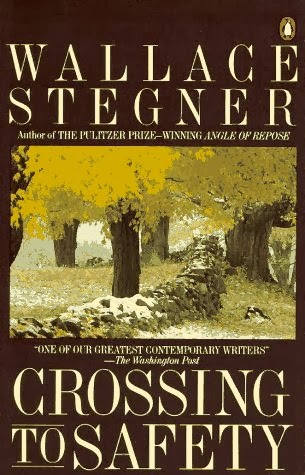
Anyway, Crossing to Safety. My brother-in-law recommended it. Highly. Which didn't make me think I wouldn't like it, but makes me concerned that I won't get it in the right way and then my brother-in-law will stop talking to me and it will cause a rift in the family and I'll never be able to see my nephew again. And for the first few pages, I didn't get it. It seemed very seventies. A new professor starting a teaching job at a midwest university, a beatific, pregnant, insanely supportive wife... I could see it as a movie with a young Dustin Hoffman. Even the cover image, a dirt road between rows of blazing fall trees, was only waiting for the professors in matching harvest-coloured tweed.

But that was only the first few pages. The story actually takes place in the mid-thirties. And what is it a story about? The jacket says things like "love and loyalty" and "steadfastness and fidelity" and "several beautifully rendered American landscapes". When I ask which story it is all I get is a voice saying "this one". It's about two couples, one relatively poor, one relatively rich, who meet at a crucial point in their lives and become lifelong friends. The rich friends are dynamic, intelligent, and generous to a degree that strains all credibility. The poor couple is sweet, genuine and accepts the largesse of the rich couple with gratitude and graciousness. The plot twists do not consist of adulterous partner-swapping or war-time catastrophes, but of the small vagaries of fate that skew the courses of our lives, and how differences in character shape how people react to those changes of course. What would be, in another story, a character flaw mentioned in passing becomes, in Stegner's hands, elevated to the level of Greek tragedy.

Stegner poses the question of how much honesty can be borne by a marriage, or a friendship. Is equality a necessity, or possible, or even desirable? Charity Lang is a wonderful character -- someone you want to know, and at the same time, someone who fully illustrates my conviction that nothing is as terrifying as someone who is certain about things.

Sometimes it makes me sad how the lives of people, even fictional people, can be contained within the pages of a single book. There is definitely sadness here, but it's the sadness you feel when things end more or less the way they should, the way you expected them to, as well as possible.

I worked at a small independent bookstore in Toronto about thirteen years ago, for a little over a year between finishing my Master's and moving to Ottawa. There was a book club doing this book, so we sold a dozen of them at one point. One of the women I worked with always said 'Stenger' instead of 'Stegner', and this made me crazy. I kept meaning to read it, but I don't think I ever even read the jacket copy. It would have been interesting to read it then, having just been married, and again now, with a few more years of marriage, and a clearer picture of how complicated it can be for a married couple to be close friends with another married couple.

I like a good anti-hero as much as the next person. But sometimes it's nice to feel that an author is sympathetic to his characters -- that he sees them clearly, but forgives them, and loves them anyway. Like a really good friend.

I recommend it. Highly.

Saturday, August 1, 2009

On second thought

He's a good husband, really. He was just trying to get the partially-assembled basketball net off of the driveway for the night. He didn't realize I wouldn't be able to drag the hose around it. And last night he didn't realize that when he wound the hose up in the hose box it would be incredibly difficult for me to unwind it enough to reach all the flowers in the front yard without extremely taxing bodily contortions and said hose box being dragged about six feet down the paved path as I hoped I could just pull on the goddamned hose hard enough that it would unwind itself. It's not his fault that my feet are made wrong which makes my back hurt most of the time and I was hot and getting bug-bitten.

I probably shouldn't have opened with "WHY do you hate my plants?".

Wednesday, July 29, 2009

What I did on my Summer Vacation Part 2. Sorta.

photo credit
creative commons license
Did I mention that I felt fantastic about myself the whole time we were away? Didn't change clothes four times before going out, didn't walk around feeling morbidly self-conscious everywhere. We were doing a fair bit of walking (some of it could even be daringly termed 'hiking', especially if you went by Eve's my-legs-are-on-fire-my-physical-resources-are-absolutely-strained-to-the-limit-my-parents-could-not-suck-more travelogue), and I thought maybe I'd even dropped a few pounds.
Turns out a bit of a suntan, dim cottage lighting and only one spotty mirror that shows you from the mid-chest up can do wonders for your self-esteem. I highly recommend it. I guess my ass just feels smaller in Eastern provinces. I may have to consider a move.
Focusing on the positive: I'm feeling grateful that the evil stomach virus I had yesterday (you know, the kind where you upchuck so violently you burst all the blood vessels in and around your eyes) did not occur in a cabin in New Brunswick or in the car on the way home. Does anyone else always emerge from a twenty-four bout of barfing with a craving for something you haven't liked before or had in years? Last time I had to send Matt out for mint chocolate chip ice cream. Now I'm all hopped up on purple popsicles and diet sprite. Unimportant, but intriguing. You don't even want to know how many times I just had to retype intriguing.

Monday, July 27, 2009

What I Did on my Summer Vacation, Part 1

Nothing like a fairly lengthy absence to make you feel like you need the Internet waaaaay more than it needs you.
Considering that I am an emotionally fragile, easily overwhelmed, slightly loony person who needs quite a lot of alone time: further considering that we have had some kind of company since just before the last day of school until two days before we left on vacation: taking into account that we vacationed with three other families and then the four of us spent twelve hours in the car together driving home....
photo credit
creative commons license
I am still feeling surprisingly well-disposed towards people. Other than myself. I sort of expected to be huddled in a corner somewhere at this point (probably the laundry room, where I have the most justification to be, plus there are big comfy only slightly smelly piles of linen and clothing in there). One of the people we travelled with called yesterday and asked us if we wanted to go to a movie and I said sure, and meant it, without even thinking "are you insane? We just spent ten days together! I don't even want your name to cross my mind for another seventy-two hours!"
Is this evidence of mental health progress on my part, or was it just the right kind of company and travelling companions? You know when you get up in the morning and the silverware is all in the wrong slots and the mugs are where the plates should be and there's a cheese grater in the bowl stack and sometimes a measuring spoon falls out and hits you on the head when you open the cupboard? That means you have a guest who got up before you and unloaded the dishwasher, and it totally rocks. You know when you have two children who aren't yours in the house but you're allowed to say to either one of them at any time, stop making that constipated pterodactyl sound right now or I'm going to beat you senseless, and there are no ill feelings? Isn't that the best thing ever? And so what if the charmingly offbeat artist uncle let my nine-year-old watch Caddyshack? It made him feel cool and grown-up and he still thinks the worst word in it was 'turd'.
More on Halifax and the Bay of Fundy and the harrowing sojourn in St. Julie, Quebec, later. Right now I think I will go spend that bit of quality time in the laundry room. Missed you, Internet.

Thursday, July 2, 2009

Things I Learned at the Cottage on Canada Day

1) A rogue three-year-old can accomplish some serious landscaping with a wayward pair of pliers.

2) There really is no limit to the number of times a skinny four-year-old will stand on the bottom of the dock ladder demanding to be lifted into the water, then immediately chatter his teeth dramatically and say "I don't want to go swimming", be put back on the ladder and... well, I'm pretty sure we were stuck in an infinite loop there for a while.


3) The 'African Lion' fireworks should really be renamed the 'African Lion immediately after eating Mexican tourist stuffed full of burritos' fireworks. (Eve: "My favourite were the farting fireworks!")

4) When you tell a kid forty-two times to put on his shoes before he goes outside and he goes outside without his shoes on and steps on something and hurts his foot you're still not allowed to say I told you so.

5) Three, four and six-year-olds generally do not consider strawberries to be dessert.

6) There is a very subtle tone difference that tells you when the six-year-old is saying No stop hitting me with the pillows and not meaning it and when she is saying the exact same thing and meaning it. If you do not immediately hear this tone difference from two rooms away and rush in to make the three and four-year-old stop hitting her with the pillows, you are a terrible excuse for a mother and you should not be allowed to have any more wine.

7) If you give a kid a fish, he may or may not eat for a day. If you teach a bunch of kids to fish, they will spend hours out on the dock happier than pigs in shit, and leave you alone to drink wine in the cottage with the other grown-ups, other than when their line is tangled or someone falls in.

Good times, my friends. Good times.

Tuesday, June 30, 2009

Badass Mommies Book Review: The Maternal is Political

The Maternal is Political: Women Writers at the Intersection of Motherhood and Social Change
Edited by Shari MacDonald Strong
I was interested but somewhat skeptical when I decided to read this -- skeptical about any of it applying to me, anyway. I couldn't think of anything indicating that motherhood had turned me into anything much different from the same timid, wishy-washy, non-confrontational person I was before I gave birth.
The book is quite interesting. As is often the case with this sort of project, most, if not all, of the contributors are quite highly educated, politically aware and articulate, so the reader must be aware of a possible lack of range. However, the writers do include a physically disabled mother, a mother who has spent time institutionalized for mental illness, a Guatemalan woman who has witnessed horrific atrocities, and a lesbian mother trying to adopt her partner's baby, so clearly there was an attempt to achieve a variety of viewpoints.
The essays are divided into three sections: Believe, Teach and Act. The 'Believe' section contains terms such as 'consciousness raising' and 'if we want a mother's movement... we have to give birth to it', which I have to admit tend to provoke a slight cringe reflex in me, although who can argue that consciousness doesn't need to be raised? The women in this section write about how becoming a mother expands your worldview, in both existential and practical ways. There's nothing like emerging from the rosy glow (or the sleepless fog) of the first few weeks or months of motherhood and realizing that your employment prospects, earning potential, benefits and personal freedoms have been severely impacted to suddenly make a woman sit up and take notice of certain practices that are unhelpful, if not downright hostile, to mothers (I apologize wholeheartedly for this sentence, I'm just too tired to rewrite it any more).
Trying to find suitable day care opens up many other cans of worms, including the reality of women from other countries caring for North American babies while spending years away from their own children. If nothing else, having children raises these issues on our radar, erases some of that blissful ignorance that might have accompanied a pre-child-encumbered state. Government policies on paid childcare leave, job protection, subsidized childcare, immigration -- these all become immediate and personal realities, which lead some women to start questioning, with varying degrees of loudness, the validity of certain protocols and assumptions.
In "Mom, Interrupted: Toward a Politics of Maternal Mental Health", Marritt Ingman interrogates the notion of postpartum depression, asking whether it is completely a matter of hormones, or rather "a falsely medicalized perspective on a problem that is at least partly political and cultural?" In other words, maybe they should be depressed, given that "for too many mothers, political reality is bleak". I tend to believe that actual postpartum depression is largely a matter of hormones and chemicals, but in a larger context Ingman's question is certainly worth asking. Violeta Garcia-Mendoza, in "Of Volcanos and Ruins and Gardens", writes about her decision to adopt a Guatemalan child, and the realization that "adoptive motherhood bears the secret that the lines we erect to partition ourselves off from others, to protect ourselves against the heaviness of the human experience, are arbitrary." The implication is that it is this inescapable realization that drives mothers to act politically not only on behalf of their own children, but for everyone's children.
Marion Winik's brave and unequivocal essay "Mothers Against Faith" really blew me away, given my own daily see-sawing between agonized half-belief and tormented skepticism. "Faith moves mountains, they say. That may well be true. It certainly knocks over buildings. Wonder, I think, may be a gentler way to live." I love this.
The "Teach" section, predictably, features educators with concerns about curriculum issues (stupid standardized tests), and also a woman with black sons in school, dealing with the reality of black men being viewed as athletes, entertainers or criminals rather than scholars, and a white woman living in India with her golden-haired fair-skinned daughter, who wonders why a rhyme they say at school reflects the reality of her appearance and not that of the Indian children (and I've done irreparable violence to another sentence). "All-Consumed: The Restoration of One Family's Values" by Alisa Gordaneer describes her really impressive committment to anti-consumerism, and how she has raised her children to be avid trash-pickers, recyclers, haters of 'cpc' (cheap plastic crap), and watchers of documentaries about how factories in China cause environmental damage. Her children prefer these, apparently, to Disney movies. Seriously. I'm thinking of asking her if she wants to adopt my children before I corrupt them any further.
The "Act" section actually answered one of my questions, which was something like 'can't I go to a political activism boot camp or something?' Beth Osnes, author of "Performing Mother Activism", actually presented a workshop called Rehearsal for Activism; she acknowledges "how similar activism is to performing, in that both force you to present yourself in public and express some predetermined content." This is what I was looking for, from someone; the admission that activism isn't something you can just leap into (okay, it isn't something I can just leap into) without some kind of coaching and encouragement. The other question floating around in my mind, which was something about how to act in the face of overwhelming odds and probably failure, was addressed beautifully by "The Mother is Standing" by Denise Roy. She writes about her passage from a former goody-two shoes rule-follower to getting arrested in a Good Friday protest at a nuclear weapons facility which did not change the world, but changed her and her community. She relates the story of A.J. Muste, a Vietman War protester who stood outside the White House nightly, and when asked if he really thought he would change U.S. policy, said "Oh, I don't do this to change the country. I do this so the country won't change me." That was one of those a-ha moments for me.
"Peace March Sans Children" by Valerie Weaver was honest and comforting, in its admission that "caring for the world or caring for the kids" are sometimes "incompatible", and that sometimes mothers of young children might need a little time off from the revolution, before coming back to "advocate from a deeper place within ourselves than we had known existed".
I'm glad I read this book. It gave me a lot to think about. And a few weeks after I had finished it, I was at a baseball game where we had some trouble with the other team's coach. The whole matter of the coach of a team of six-year-olds needing to win no matter what is a matter for another post, but at one point, when he was being fairly nasty and confrontational, I suddenly found myself up out of my comfortable lawn chair, on my feet.
I didn't actually punch out the coach, or get arrested or anything. Still... I think I might have been ready for a little activism. I am mother... hear me squeak in a vaguely threatening and self-assured manner.

Monday, June 29, 2009

Stop and Reflect (or the other way around)

A friend of mine got a ticket for not coming to a full stop at a stop sign a couple of weeks ago. It was a stop sign at a four-way stop near my house. Around the same time, I was riding with someone who I noticed making full and complete stops at every stop sign. In recent years, I've pretty much become the queen of the rolling stop. I sort of resent the whole business -- if there are other cars around, fine, but if there's no other visible traffic, isn't it a waste of time to step on the brake until you feel that little jerk that means you are now well and truly stopped, then have to get going again?
photo credit
creative commons license

OR is the fact that I think that just evidence that I'm buying into a fast-food, hurry hurry rush rush culture, too busy for courtesy, contemplation or correct behaviour? 

So I've been stopping for real at stop signs. Partly because I don't want to get a ticket, partly because it makes me feel a little smug (especially when I see the people behind me almost drive into me and then get mad, the same way I do when I think people stop for too long at stop signs), partly just to try something new. It's an interesting feeling. A little pause every so often, for no good reason (because I still think it's kind of dumb).

But yesterday I was driving back to my Mom's house from our house. My husband was away for a week and a half, then my brother in law was here for two nights, then my cousin who I've seen three times in twenty-five years was here on the last day of school and needed to be shown around Ottawa, then my sister and her two kids came on the last day of school and stayed for the week-end. My house is only a few minutes away from my Mom and Dad's, and we spent the week-end shuffling between the two houses and the beach and the waterpark with various combinations of kids and adults. And I realized why I rarely came to a full stop at a stop sign before. 

It's because sometimes, when you come to a full stop, it's really, really hard to make yourself go again.

I Will Stop Talking About Camping Any Minute Now

We are going to our friends' cottage for Labour Day weekend, which is obviously wonderful, but it's also giving me a tiny bit of cam...