After my four-hour nap at the hotel in San Francisco, I popped up feeling remarkably refreshed and ready to do... something. My husband had headed to the trade show, so I got dressed and went out and walked around Union Square and the streets around the hotel. I had a drawstring bag on my back for book shopping and to hold my water bottle. After the first bookstore and book purchase I realized I hadn't eaten since the yogurt and fruit on the plane at 4 a.m. or something. I looked up a cafe and started to walk in what I thought was the right direction.
Do you have any luck with walking directions on your phone? I never do. I use Google maps (I think) for driving, and it is generally flawless and never fails me. For walking I feel like my phone is just fucking with me. Walk this way. No, that way. Six paces west, bend down, spin around, do the hokey pokey and cross the street. I walked fairly far up hill (and it's San Francisco, up is UP) and realized I was moving further away instead of closer to my destination, and threw up my hands in defeat. I had looked up fun things to do in San Francisco a few days before and one suggestion was to eat at The Rotunda in Neiman Marcus. Our hotel was on a street lined with big department stores, which means I could see Neiman Marcus from my present position, so I thought I would try that.
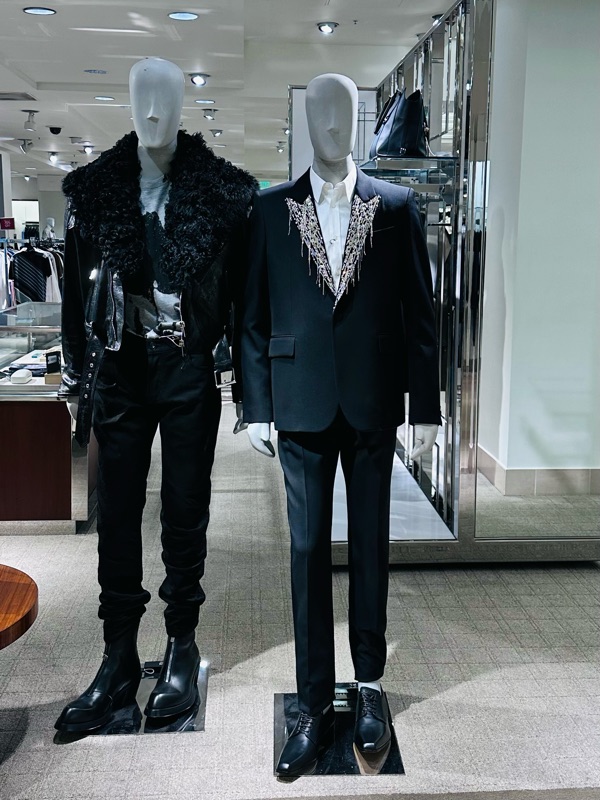
I rode the escalator up past several floors of extremely fancy wares, which was a spectacle all on its own. I seldom go anywhere to eat without a reservation because neurotic, so I walked up and the woman at the counter smiled and I said "are you full?" and she said "Never!" then paused and said "well that's not true, sometimes we are. But not now!" which made me feel better because clearly I'm not the only person who makes it weird.
She led me to a small table for two in between two very closely spaced tables for two with two men (turned out to be finance bros) to my left and two women (there for high tea) to my right. I swung my drawstring bag off my back and could suddenly feel that, although I had checked VERY CAREFULLY that the lid to my water bottle was on very tightly, it had leaked. So in my mind now is 1) are the two books I put in going to be soaked, 2) am I going to drop water all over this fancy restaurant banquette, 3) why do I EVER try to do anything like this, I am too WEIRD and AWKWARD and STUPID, what was I even THINKING.

Before slinking out in abject defeat, I took a deep breath. I pulled my two books out and ascertained that the one I had just bought was unscathed and the one I had brought from home was only a little damp on one corner. I pulled the bottle out and set it upright on the table even though it wasn't really fancy enough. I took another deep breath and darted my eyes left and right to make sure the people at the other tables weren't staring at me wondering what this eminently unsuitable urchin was doing invading their space.
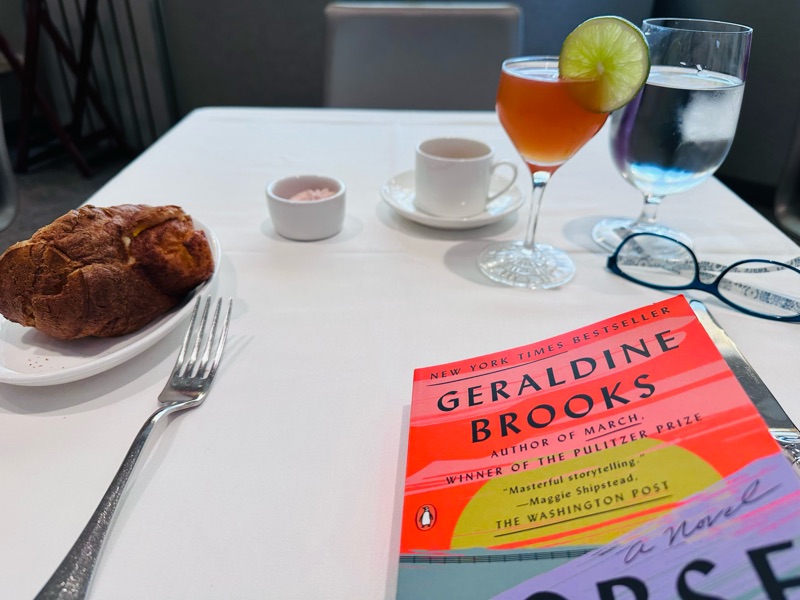
I think I learned on this trip once and for good that I just don't love being a solo tourist when I don't have a clear itinerary of what I want to do. I can do museums and art galleries by myself, I don't mind traveling alone, but wandering around a city on my own, while I admire people who can do it, just isn't in my sweet spot. But I do want to get comfortable eating out alone, so I ordered a lobster club and cut it into pieces so I could eat and read my book, and I had a Tossed By the Waves, and I mostly tuned out the deathly boring droning of the finance bros and the less boring conversation of the two women (except the part about Mike and his now ex-wife - I couldn't help thinking that these chicks were being pretty hard on the ex-wife and letting Mike skate, plus when one woman said "I'm going to have the sweet scone first and the savoury one after" I had to restrain myself from saying "What? WHY?").
Non-fiction
Everything Happens for a Reason: and Other Lies I've Loved by Kate Bowler: Synopsis from Goodreads: A divinity professor and young mother with a Stage IV cancer diagnosis explores the pain and joy of living without certainty.
Thirty-five-year-old Kate Bowler was a professor at the school of divinity at Duke, and had finally had a baby with her childhood sweetheart after years of trying, when she began to feel jabbing pains in her stomach. She lost thirty pounds, chugged antacid, and visited doctors for three months before she was finally diagnosed with Stage IV colon cancer.
As she navigates the aftermath of her diagnosis, Kate pulls the reader deeply into her life, which is populated with a colorful, often hilarious collection of friends, pastors, parents, and doctors, and shares her laser-sharp reflections on faith, friendship, love, and death. She wonders why suffering makes her feel like a loser and explores the burden of positivity. Trying to relish the time she still has with her son and husband, she realizes she must change her habit of skipping to the end and planning the next move. A historian of the "American prosperity gospel"--the creed of the mega-churches that promises believers a cure for tragedy, if they just want it badly enough--Bowler finds that, in the wake of her diagnosis, she craves these same "outrageous certainties." She wants to know why it's so hard to surrender control over that which you have no control. She contends with the terrifying fact that, even for her husband and child, she is not the lynchpin of existence, and that even without her, life will go on.
On the page, Kate Bowler is warm, witty, and ruthless, and, like Paul Kalanithi, one of the talented, courageous few who can articulate the grief she feels in the face of her impending death.

-”...favorite topic; the next thing. How could we improve our lives? What should we do next? As we walked through the tall Carolina oaks on a fall trail dusted with Technicolor leaves, my mind hummed with possible futures. Always. If I were to invent a sin to describe what that was – for how I lived – I would say it was simply that I didn’t stop to smell the roses. It was the sin of arrogance, of becoming impervious to life itself. I failed to love what was present and decided to love what was possible instead.
I must learn to live in ordinary time but I don’t know how.”
“The publisher even let me do my own reading for the audiobook version. This is despite the fact that, five minutes into the recording, the sound technician piiped his voice into the sound booth where I was sitting, marveling at my own prose.
‘Is it all…um…going to be like this? he asked, knowing that we had weeks together of recording each chapter.
‘Yes?’ I replied, realizing too slowly that he wasn’t offering me a compliment.
Quite frankly, this book was a bit of a mess. Is it a memoir, or a series of essays? Is Bowler critical of the Prosperity Gospel, or is she in favour of it, or somewhere in the middle? I'm just trying to keep myself honest, because the truth is I don't really care, I still really liked it. She's funny and self-deprecating and sees the absurdity in the most tragic of circumstances, and she approaches being gravely ill the way I probably would too. That's not to say it's the right way, just that it was relatable for me. I can't quite agree that this is comparable to Paul Kalanithi - it didn't have the gravitas of When Breath Becomes Air, or the literary quality of The Bright Hour. But it's a really good depiction of what happens when a devout Christian who believes that everything is God's plan encounters something that seems starkly wrong and unfair. (Also the author is to all appearances alive and well.)
The Violet Hour: Great Writers at the End by Katie Roiphe: Synopsis from Goodreads: From one of our most perceptive and provocative voices comes a deeply researched account of the last days of Susan Sontag, Sigmund Freud, John Updike, Dylan Thomas, and Maurice Sendak—an arresting and wholly original meditation on mortality\
In The Violet Hour, Katie Roiphe takes an unexpected and liberating approach to the most unavoidable of subjects. She investigates the last days of five great thinkers, writers, and artists as they come to terms with the reality of approaching death, or what T. S. Eliot called “the evening hour that strives Homeward, and brings the sailor home from sea.”
Roiphe draws on her own extraordinary research and access to the family, friends, and caretakers of her subjects. Here is Susan Sontag, the consummate public intellectual, who finds her commitment to rational thinking tested during her third bout with cancer. Roiphe takes us to the hospital room where, after receiving the worst possible diagnosis, seventy-six-year-old John Updike begins writing a poem. She vividly re-creates the fortnight of almost suicidal excess that culminated in Dylan Thomas’s fatal collapse on the floor of a Greenwich Village tavern. She gives us a bracing portrait of Sigmund Freud fleeing Nazi-occupied Vienna only to continue in his London exile the compulsive cigar smoking that he knows will hasten his decline. And she shows us how Maurice Sendak’s beloved books for children are infused with his lifelong obsession with death, if you know where to look.
The Violet Hour is a book filled with intimate and surprising revelations. In the final acts of each of these creative geniuses are examples of courage, passion, self-delusion, pointless suffering, and superb devotion. There are also moments of sublime insight and understanding where the mind creates its own comfort. As the author writes, “If it’s nearly impossible to capture the approach of death in words, who would have the most hope of doing it?” By bringing these great writers’ final days to urgent, unsentimental life, Katie Roiphe helps us to look boldly in the face of death and be less afraid.
-”I wrote long apologetic letters and emails about how much I understood if they didn’t want to talk to me. ‘I don’t want to impose on your privacy,’ I would write. ‘I would be very grateful for your time but completely understand if you don’t want to talk.’ The people I was interviewing frequently started reassuring me; that was how awkwardly I was coming across. But the conversations we had ended up, very often, being among the most extraordinary I’ve had in my life.”
-”Ancient Egyptians used to read the Book of the Dead to learn practical tips on how to navigate the underworld – like how to not have your head cut off in the underworld, or how to not enter the underworld upside down – but we don’t have a Book of the Dead.”

Black in Blues: How a Color Tells the Story of My People by Imani Perry (the National Book Award Winner's Cultural Meditation on Race, Blues, and Identity): Synopsis from Goodreads: A surprising and beautiful meditation on the color blue—and its fascinating role in Black history and culture—from National Book Award winner Imani Perry
Throughout history, the concept of Blackness has been remarkably intertwined with another color: blue. In daily life, it is evoked in countless ways. Blue skies and blue water offer hope for that which lies beyond the current conditions. But blue is also the color of deep melancholy and heartache, echoing Louis Armstrong’s question, “What did I do to be so Black and blue?” In this book, celebrated author Imani Perry uses the world’s favorite color as a springboard for a riveting emotional, cultural, and spiritual journey—an examination of race and Blackness that transcends politics or ideology.Perry traces both blue and Blackness from their earliest roots to their many embodiments of contemporary culture, drawing deeply from her own life as well as art and history: The dyed indigo cloths of West Africa that were traded for human life in the 16th century. The mixture of awe and aversion in the old-fashioned characterization of dark-skinned people as “Blue Black.” The fundamentally American art form of blues music, sitting at the crossroads of pain and pleasure. The blue flowers Perry plants to honor a loved one gone too soon.
Poignant, spellbinding, and utterly original, Black in Blues is a brilliant new work that could only have come from the mind of one of our greatest writers and thinkers. Attuned to the harrowing and the sublime aspects of the human experience, it is every bit as vivid, rich, and striking as blue itself.

-Even though, as a child of the 1970s and a student of history, I knew a fair amount about the dashed hopes of post-colonialism and how it has revealed that Black people have the capacity for injustice like anyone else, it keeps striking me as astonishing that people who had been so recently enslaved could pivot into colonization…”
The most cherished of these glass necklaces that Montesquieu scoffed at were made of blue beads. Valuing beauty over scarcity indicated, according to him, a lack of civilization. He seemed to have no qualms about making human beings into chattel, however.”
Difficult to describe well. Often I have started an essay or a project and then, a good way in, felt that I have lost my grasp on the thesis I held originally. I have to think that happened multiple times to Imani Perry during the writing of this book. At one point she says something can be read a certain way "with some compensatory effort on my part", and this phrase could be extended to much of the book. Not that I'm angry about it in the least. She writes beautifully, I learned a lot, and everything she says seems true, in the most important sense of the concept.
This American Ex-Wife: How I Ended My Marriage and Started My Life: By Lyz Lenz: : Synopsis from Goodreads: A manifesto on the gender politics of marriage (bad) and divorce (actually pretty good!) in America today, and an argument that the former needs a reboot
Studies show that nearly 70 percent of divorces are initiated by women—women who are tired, fed up, exhausted, and unhappy. Journalist Lyz Lenz is one such woman whose life fell apart after she reached a breaking point in her twelve-year marriage. In this exuberant and unapologetic book, Lenz flips the script on that narrative and preaches the good gospel of the power of divorce.The end of a marriage is often seen as the failure of the individual—most often the woman. We've all seen how media portray divorced women: sad, lonely, drowning their sorrows in a bottle of wine, desperate for a new man. It’s as though they did something wrong, so they’ve been cast out from society. Lenz sees divorce as a practical and powerful solution for women to take back the power they are owed, while examining why we call divorce a failure when it's heterosexual marriage that has been flawed all along. How can women succeed in marriage when most relationships are based on inequality?
This book weaves reportage with sociological research, literature with popular culture, and personal stories of coming together and breaking up to create a kaleidoscopic and poignant portrait of American marriage today. Lenz argues that the mechanisms of American power, justice, love, and gender equality remain deeply flawed, and that marriage, like any other cultural institution, is due for a reckoning. Unlike any other book about divorce, this raucous manifesto for acceptance, solidarity, and collective female refusal takes readers on a riveting ride—all while pointing us toward something a little freer.

-”Often, when discussing singleness, there is a focus on what is lacking from a life unpartnered. Rarely do we consider what must be exchanged for a life lived with someone else.”
“Some women tell me how they trained their partners. Sure, they came rough and reluctant, but now they do the dishes without complaining. And they’ll cook dinner some nights. See? See. Maybe, they imply, if I had tried harder, worked harder, trained my husband, stayed miserable a little longer, I could have stayed married. As if that was the one thing I wanted to spend my time on – training a grown man like a horse.”
Three and a half. Lenz does a substack I like, which led me to this book. It's very much a memoir mixed in with some statistics, so I wasn't expecting Susan Faludi, or shouldn't have been. Her husband was so terrible that I am absolutely overjoyed that she got away from him, and I agree with her opinion (and all of the supporting evidence) that marriage overwhelmingly supports men and the patriarchy. I'm not sure I needed to know how many terrible men she dated and slept with after she she finally ditched the first one, but she was raised religious and married young, so fair enough. I grew a little weary of the detailing of her episodes of 'sobbing on the floor', but again, it's an honest account.
I read a couple of snotty reviews of this (by conservative men or publications) that totally cherry-picked negative aspects while accusing her of cherry-picking statistics and completely ignoring what a piece of crap her husband was, which makes me feel even more defensive of it. The political right seems to be frantic to convince women that marriage is still an attractive prospect, even as fewer of them are buying in.
Fiction
You Exist Too Much by Zaina Arafat: : Synopsis from Goodreads: On a hot day in Bethlehem, a 12-year-old Palestinian-American girl is yelled at by a group of men outside the Church of the Nativity. She has exposed her legs in a biblical city, an act they deem forbidden, and their judgement will echo on through her adolescence. When our narrator finally admits to her mother that she is queer, her mother's response only intensifies a sense of shame: "You exist too much," she tells her daughter.
Told in vignettes that flash between the U.S. and the Middle East--from New York to Jordan, Lebanon, and Palestine--Zaina Arafat's debut novel traces her protagonist's progress from blushing teen to sought-after DJ and aspiring writer. In Brooklyn, she moves into an apartment with her first serious girlfriend and tries to content herself with their comfortable relationship. But soon her longings, so closely hidden during her teenage years, explode out into reckless romantic encounters and obsessions with other people.Her desire to thwart her own destructive impulses will eventually lead her to The Ledge, an unconventional treatment center that identifies her affliction as "love addiction." In this strange, enclosed society she will start to consider the unnerving similarities between her own internal traumas and divisions and those of the places that have formed her.
Opening up the fantasies and desires of one young woman caught between cultural, religious, and sexual identities, You Exist Too Much is a captivating story charting two of our most intense longings: for love, and a place to call home.

-”I stepped out of the bathroom and looked at my uncle. I examined my new curves against his ridiculous pasty legs, gangly and covered in sporadic patches of hair, shorts tight against his thighs like boxer briefs. It occurred to me in that moment to question why, as a man, his bare legs were somehow less troubling than mine. It was a double standard, a shame I had simply accepted until then. In acquiring my gender, I had become offensive.”
-”’Maybe she’s busy,’ Renata responded. ‘She does exist outside of your relationship, you know.’
I forgave Renata her misplaced annoyance. She had put up with me panicking about nearly everything for years. ‘Your worries are like water,’ she often said. ‘The moment one flows out, another floods into fill the space.’”
-”Ya madrassa, ya madrassa,’ which means, ‘School, O school’ in Arabic, or, depending on which dictionary you consult, ‘terrorist training camp.’”
Goddammit, you guys, I read this back last January when I was ON IT as far as reviewing books, I was going to get my shit together OUT OF THE GATE. So what the hell? I do remember that I had to keep checking and re-checking that this was fiction and not memoir, because especially the passages about the narrator's interactions with her mother seemed so true to life. Oh, I found a review I posted on my book bingo group, but it doesn't have that much more detail. A Palestinian-American lesbian with a maybe-narcissist mother who is in a damaging love-addiction cycle. She was a very effectively-written character in that she drove me crazy making the same mistakes over and over again, but her trauma was evident.
Vantage Point by Sara Sligar: : Synopsis from Goodreads: Succession meets Megan Abbott in this seductive Gothic suspense novel about the dramatic downfall of one of America’s most affluent families.
The old-money Wieland family has it all—wealth, status, power. They’re also famously cursed. Clara and her brother Teddy grew up on a small island in Maine in the shadow of their parents’ tragic deaths, haunted by rumors and paparazzi. Fourteen years later they’ve mostly put their turbulent past to rest. Teddy has married Clara’s best friend, Jess, and the three of them have moved back home to take over the sprawling, remote family mansion known as Vantage Point. Then Teddy decides to run for the Senate—an unnerving prospect made much worse when intimate videos of Clara are leaked online. The most frightening part is that she doesn't remember filming any of them. Are the videos real? Or are they deepfakes? Is someone trying to take down the Wielands once and for all?Everyone thinks Clara is losing her grip on reality, but she knows the videos are only the beginning. Years ago the curse destroyed her parents. Now it’s coming for her. Brimming with palpable tension, Vantage Point reveals a twisted web of family secrets and political ambition that raises questions about the blurred lines between public and private personas and the nature of truth in the digital age.

-”Most summer kids vanished from our lives as soon as they aged out of family vacations, but Conrad and Teddy eventually ended up in the same class as Harvard, even roomed together a couple years. I think that’s why Teddy felt obligated to invite him to pitch WFCI, even though Conrad’s work experience is limited to a few failed crypto start-ups with names like Jaggr and PeskBall. He hasn’t grown up to be interesting. He has a firm handshake and a pseudo-hipster undercut. His hobbies are probably rock climbing and grilling meat. I’ve dated a thousand men like him, back when I still dated men.”
-”The first thing the police would ask: How could you not know?
I’m not sure when it became pathological to be the way I am. At Halpern, all the girls seemed alienated from their bodies. Surprised by their own mood swings, furious at their zits. Everyone was always looking at their profile in the mirror, the curve of their stomach. Ugh, is that me? Ugh, is that my stomach? We’d turn to each other for help. Does this make my ass look big? Everyone needed a second opinion. Everyone was a stranger to themselves.
And then at some point it changed. They veered onto a new course, while I kept going, trudging forward into the blizzard. One day I looked up and saw that I was alone. And the snow had covered the footprints behind me; I couldn’t see how to return.”
Coincidentally read this fairly soon after Long Island Compromise, and the themes about wealth and how damaging it is to the havers as well as the have-nots were extremely resonant. I used this for 'character with a disability' in book bingo, the disability being an eating disorder that the supposedly 'cursed' family's daughter has. The son is married to the daughter's best friend and running for office, and the plot is purportedly about deepfake videos, but really the book is again about wealth and how it distorts personalities and relationships. And also, if someone puts out a false video or picture of you, should your best friend or spouse believe in your innocence without question? (I am BAFFLED about how some reviewers didn't get this, but I digress lol). The horrors of altered videos are compounded when a character's mental illness makes them unsure of whether or not the events in question could have happened.
The Blue Castle by L.M. Montgomery: : Synopsis from Goodreads: An unforgettable story of courage and romance. Will Valancy Stirling ever escape her strict family and find true love?
Valancy Stirling is 29, unmarried, and has never been in love. Living with her overbearing mother and meddlesome aunt, she finds her only consolation in the "forbidden" books of John Foster and her daydreams of the Blue Castle--a place where all her dreams come true and she can be who she truly wants to be. After getting shocking news from the doctor, she rebels against her family and discovers a surprising new world, full of love and adventures far beyond her most secret dreams.

Our Wives Under The Sea is the debut novel from Julia Armfield, the critically acclaimed author of Salt Slow. It’s a story of falling in love, loss, grief, and what life there is in the deep deep sea.
-”’What you have to understand,’ she says, ‘is that things can thrive in unimaginable conditions. All they need is the right sort of skin.’”
-”When I asked her once (with a glibness that really should have been embarrassing) if the appeal of the ocean lay, to her, in some sense of religious universality, of God being everywhere, she had shaken her head and told me, No – what it is that I’m fucking furious I can’t do the thing that I wanted to do, and I feel better in places where there aren’t any churches. I was pretty chastened by this and didn’t ask her any personal questions for a long time afterward, which I think is what she’d hoped.”

I started reading this and a few pages in thought that the writing was beautiful but that everything was described at such a remove that it was probably going to be a very cerebral reading experience and that I might have to push myself to get all the way through it. And then I found myself eager to pick it up again and again, and in the end found it much more emotionally affecting than I expected to. There are some really poignant parallels to caregiving in a relationship where one partner falls ill. I'm always attracted to writing that evokes the mysteries of deep water - the fact is that the ocean is just fucking enormous and extremely mysterious and terrifying if you think about it in any depth (ha).
Manhattan Beach by Jennifer Egan:: Synopsis from Goodreads: Anna Kerrigan, nearly twelve years old, accompanies her father to visit Dexter Styles, a man who, she gleans, is crucial to the survival of her father and her family. She is mesmerized by the sea beyond the house and by some charged mystery between the two men.
Years later, her father has disappeared and the country is at war. Anna works at the Brooklyn Naval Yard, where women are allowed to hold jobs that once belonged to men, now soldiers abroad. She becomes the first female diver, the most dangerous and exclusive of occupations, repairing the ships that will help America win the war. One evening at a nightclub, she meets Dexter Styles again, and begins to understand the complexity of her father’s life, the reasons he might have vanished.With the atmosphere of a noir thriller, Egan’s first historical novel follows Anna and Styles into a world populated by gangsters, sailors, divers, bankers, and union men. Manhattan Beach is a deft, dazzling, propulsive exploration of a transformative moment in the lives and identities of women and men, of America and the world.
-”For reasons that eluded Dexter, his sons liked to enter promotional contests, usually at picture theaters. They tap-danced, turned somersaults, hung from bars upside down, and whistled through their teeth. When successful, they brought home bugles or harmonicas or roller skates – items they already owned or could easily afford. Dexter feared they were constitutionally unserious.”

Tabby watched her grandfather, but the old man’s gaze never touched her. A weakness of his generation: they’d no idea of the worth of women.”
I can't remember why I borrowed this - if there was a recommendation from someone - but I really liked it. It sort of played like a Tree Grows in Brooklyn/Wiseguy mashup. I did get a little confused about Eddie Kerrigan's timeline, but I loved Anna's journey from precocious daughter to determined young woman. The fine tracing of the motives and precarious positions of the organized crime members are also quite fascinating. It was long but very readable.
The Library of Lost Dollhouses by Elise Hooper:: Synopsis from Goodreads: When a young librarian discovers historic dollhouses in a hidden room, she embarks on an unexpected journey that reveals surprising secrets about the lost miniatures.
Tildy Barrows, Head Curator of a beautiful archival library in San Francisco, is meticulously dedicated to the century’s worth of inventory housed in her beloved Beaux Art building. She loves the calm and order in the shelves of books and walls of art. But Tildy’s uneventful life takes an unexpected turn when she, first, learns the library is on the verge of bankruptcy and, second, discovers two exquisite never-before-seen dollhouses. After finding clues hidden within these remarkable miniatures, Tildy starts to believe that Belva Curtis LeFarge, the influential heiress who established the library a century ago, is conveying a significant final message.With a newfound sense of spontaneity, Tildy sets out to decipher the secret history of the dollhouses, aiming to salvage her cherished library in the process. Her journey to understand introduces her to a world of ambitious and gifted women in Belle Époque Paris, a group of scarred World War I veterans in the English countryside, and Walt Disney’s bustling Burbank studio in the 1950s. As Tildy unravels the mystery, she finds not only inspiring, overlooked history, but also a future for herself, filled with exciting possibilities—and an astonishing familial revelation.
Spanning the course of a century, The Library of Lost Dollhouses is a warm, bright, and captivating story of secrets and love that embraces the importance of illuminating overlooked women of the past.

-”’No kidding. Why did she think a dollhouse would raise people’s spirits?’
‘She believed putting creativity and beauty on display would cheer people up. And interestingly enough, she was onto something. There’s actually a psychological rationale to explain our affinity for small things: dollhouses offer us a sense of control and imagination. They can provide a feeling of agency.Miniatures allow us to create the world as we’d like to see it.’”
-”’Well, glad you look better now. I mean, feel better now,’ Tildy fumbled, annoyed. She’d turned into such a cliche: cute guy appears, girl loses her mind.”
I love when the books I read accidentally echo each other with themes or storylines or descriptions. The last book I read touched on reclaiming lost female voices from history, similarly to this one. The setting of the main library was intoxicating. The descriptions of the dollhouse and miniature construction were really cool to read (although sometimes I wanted more, and some of the ways the scale of the little things was described were suspect and made it sound like it couldn't possibly all be proportional, but that's probably just me). The historical and present-day timelines went together quite well, and you gotta love the early-century gay and bi representation. The writing style was perhaps a little more straightforward and the story a little more pat than I generally prefer, but occasionally a romance trope was subverted and overall it was just a really nice story, and sometimes that's a good thing to come across.
Elita by Kirsten Sundberg Lunstrom: : Synopsis from Goodreads: An American literary take on the Nordic noir genre
Unfolding during the moody Pacific Northwest winter of 1951, we follow Bernadette Baston, scholar of child development and language acquisition, as she travels to a penitentiary on the remote island Elita in the Puget Sound to consult on a curious case: two guards have discovered an animal-like adolescent girl living alone in the cold woods beyond the prison’s walls. There are few answers, but many people who know more than they are saying. According to official reports, the girl, dubbed Atalanta, does not speak. Is her silence protecting someone? The prison warden, court-appointed guardian, and police detective embroil Bernadette in resolving a secret that the tight-knit island community has long held, and her investment in the girl’s case soon becomes more personal than professional. As a mother, wife, and woman bound by mid-twentieth-century expectations, Bernadette strategizes to retain the fragile control she has over her own freedom, identity, and future, which becomes inextricably tied to solving Atalanta’s case.
-”What do you do when your love for another person outpaces reason? When the fear that is the flip side of that love is irrational at times, and overwhelming? When the boundaries set so carefully around your heart and time and trajectory dissolve? Parenthood is the swing and the drop, the plunge into a world inverted. Parenthood shatters a person, fragments her, splits and bursts her into something different – something bigger than she was before, but also something less controlled. This is not a devastation as much as a reconstruction, Bernadette thinks.”
-”It would break her to be without him again, Bernadette knows. But still, she thinks, a father’s absence can be weathered. It can be forgiven as a mother’s absence never can be. A mother’s absence is fodder for fairy tales, for nightmares. It’s a wound that doesn’t close. A broken wing, never healed. A heart with an irregular beat.”

I really enjoyed reading this, and I was most of the way through it before I really became aware that parts of it didn't make a whole lot of sense. I don't really understand why Bernadette was so adamant about not being a teacher, when she did actually teach college students. I didn't really understand the power struggle between her and Nina. The writing about the various facets of motherhood and the struggle of a woman who wants to be a mother and a scholar - particularly in the 1950s - was quite wonderful, and the relationship between Bernadette and her husband was odd but I appreciated that it wasn't formulaic. It was extremely atmospheric - for someone who is always too warm, the multiple references to stuffy rooms or people sweating under their clothes haunts me almost more than the girl abandoned in the woods (not really). In retrospect, 'Atalanta' seems like an underused device for the rest of the story. Sometimes I read a book that I can understand is well written and laudable but I don't enjoy the reading experience that much. Sometimes I read something that is clearly wanting in some regards and still really like it. Life and reading are mysterious.
The Accidental Favorite by Fran Littlewood: : Synopsis from Goodreads: From the New York Times bestselling author of Amazing Grace Adams comes a wryly resonant and deeply moving family dramedy investigating the question so many of us have asked ourselves: do my parents have a favorite?
Vivienne and Patrick Fisher have done an excellent job raising their three daughters, Alex, Nancy, and Eva. They’re well-adjusted women with impressive careers, caring partners, exciting hobbies, and sweet children. So it’s with great anticipation that three generations of Fishers gather at a beautiful glass house in the English countryside for a weeklong celebration of Vivienne’s seventieth birthday. But when Patrick’s reaction to a freak accident on the first day of the trip inadvertently reveals that he has a favorite daughter, no one is prepared for the shockwaves it sends through the family.
Decades-old unresolved sibling rivalries are suddenly unmasked. And be it newly uncovered smoking habits, ancient crushes, or private doubts about life decisions both big and small, no one’s secrets are safe. Still-tender wounds are reopened amid an audience of friends, husbands, grandchildren, and even coworkers, and as the family's past is re-written, they find themselves suddenly unmoored.In a lively, poignant examination of memory, sisterhood, and family ties, Fran Littlewood reminds us just why it is that people in glass houses shouldn’t throw stones.
-”The golden child… A memory – a series of memories – seizes her. It’s what Stella Wilson used to call her, and she hadn’t understood it…. Is she the golden child? She has always hated that expression. If she is, she doesn’t want it. Is that true? She both does and doesn’t want it, this poison accolade.”

I opened this one day to read a few pages and see if I wanted to finish it, since it's an overdue library book. Looked up a couple of hours later having read most of it. It took me kind of an embarrassingly long time to stop having to flip back and forth to remember which sister was which. It was compulsively readable and had some flashes of deep insight on family dynamics and often-inescapable roles that are taken on due to birth order. The last quarter or so there were some things that were a little too on-the-nose and didn't need to be so dramatically stated. Reading this kind of book - and how many of them there are - always makes me wonder briefly if so many families are this fucked up. Then I think 1) a happy, well-adjusted family that never fights is going to make a pretty boring book and 2) when I think a little bit more about all the families I know, yes, many of them are in fact this fucked up.
Audition by Katie Kitamura: : Synopsis from Goodreads: One woman, the performance of a lifetime. Or two. A mesmerizing Mobius strip of a novel that asks who we are to the people we love.
Two people meet for lunch in a Manhattan restaurant. She’s an elegant and accomplished actress in rehearsals for an upcoming premiere. He’s attractive, troubling, and young—young enough to be her son. Who is he to her, and who is she to him? In Audition, two competing narratives unspool, rewriting our understanding of the roles we play every day—partner, parent, creator, muse—and the truths every performance masks, especially from those who think they know us best.
-”He was like a familiar stranger, someone you have known for a very long time but at a distance, or perhaps someone you knew long ago, for a brief but intense period, so that the familiarity was always mitigated, always compromised, always a little uncanny.
This was, perhaps, what it meant to have a child grow up. That distance finally achieved, in itself a kind of necessary estrangement.”

I liked this, but not as rapturously as some. The writing was certainly beautiful, and I am fine with books that minutely dissect characters, actions and motivations. The central conceit married very well with writing about performance, theatre, and the experience of raising children and seeing them become independent adults. I felt a certain crankiness that this is perhaps that kind of book that people who claim not to like speculative fiction will rhapsodize about as if it is something that not been done many times in speculative fiction - the way people gushed about 50 Shades of Gray as if it isn't possible to find a comparable example in erotic literature (I'm pretty sure there is, with better examples of consent), or extolled the virtus of The Da Vinci Code and then never looked for any other examples of historico-religious fiction. Then again, I would be thrilled if mainstream readers became more open to speculative fiction, so I should probably not complain (also, my own defensiveness about my love of speculative fiction and the perception that some people think this makes me flaky is possibly in play as well). There was a passage or two that was a little too on the nose, as if the author didn't trust the reader to get there on her own. Additionally, the ending made me feel the same irritation as I did at the end of the movie Beau is Afraid - one of the very few A24 movies I have not liked. I am fine with some ambiguity and open-endedness, but sometimes it falls just outside the line.
We All Want Impossible Things by Catherine Newman: Who knows you better than your best friend? Who knows your secrets, your fears, your desires, your strange imperfect self? Edi and Ash have been best friends for over forty years. Since childhood they have seen each other through life's milestones: stealing vodka from their parents, the Madonna phase, REM concerts, unexpected wakes, marriages, infertility, children. As Ash notes, 'Edi's memory is like the back-up hard drive for mine.'
So when Edi is diagnosed with terminal cancer, Ash's world reshapes around the rhythms of Edi's care, from chipped ice and watermelon cubes to music therapy; from snack smuggling to impromptu excursions into the frozen winter night. Because life is about squeezing the joy out of every moment, about building a powerhouse of memories, about learning when to hold on, and when to let go.

This is not a perfect book. Among other things, the main character is way too forgiving about past sexual harassment and I found that jarring. And most kids would probably not roll with their mom sleeping with multiple members of her friend's care team. That aside, this is nearly a perfect book - of course, I say this as someone whose family deals with everything with terrible humour. From the time a character 'rolled over nudely' I was hooked. It is hysterically funny and hysterically sad and warm and full of love - the family kind and the friend kind and the romantic kind - and really illustrates that - for people like us, at least - the way to survive life (until you don't) is to find people you can laugh with. About literally everything.
Fervor by Toby Lloyd: : Synopsis from Goodreads: A chilling and unforgettable story of a close-knit Jewish family in London pushed to the brink when they suspect their daughter is a witch.
Hannah and Eric Rosenthal are devout Jews living in North London with their three children and Eric's father Yosef, a Holocaust survivor. Both intellectually gifted and deeply unconventional, the Rosenthals believe in the literal truth of the Old Testament and in the presence of God (and evil) in daily life. As Hannah prepares to publish a sensationalist account of Yosef's years in war-torn Europe—unearthing a terrible secret from his time in the camps—Elsie, her perfect daughter, starts to come undone. And then, in the wake of Yosef’s death, she disappears. When she returns, just as mysteriously as she left, she is altered in disturbing ways.
Alive with both the bristling energy of a great campus novel and the unsettling, ever-shifting ground of a great horror tale, Fervor is at its heart a family story—where personal allegiances compete with obligations to history and to mysterious forces that offer both consolation and devastation.
Religion, trauma, mental illness, possible demonic possession?

A domestic horror story that builds to an apocalyptic ending, Killing Stella distills many of the themes of Marlen Haushofer’s acclaimed novel The Wall into a claustrophobic, gothic, shattering novella.
I started reading this and found it evocative of The Sorrows of Young Werther or In Search of Lost Time by Proust - it was vivid but kind of archaic. People said things coldly, people were flushed and bright-eyed with feverish emotion, words like 'repellent' and 'remonstrate' were used. I had picked up the hold without having any idea of why I had requested it - when I looked it up I found that it was a reprint from the 50s and translated from the Austrian, which explained a lot. It packed a lot of impact into a compact form, and was beautifully written, if not terribly strong emotionally.
Heart the Lover by Lily King:: Synopsis from Goodreads: You knew I’d write a book about you someday.
Our narrator understands good love stories—their secrets and subtext, their highs and their free falls. But her greatest love story, the one she lived, never followed the simple rules.In the fall of her senior year of college, she meets two star students from her 17th-Century Lit class: Sam and Yash. Best friends living off-campus in the elegant house of a professor on sabbatical, the boys invite her into their intoxicating world of academic fervor, rapid-fire banter and raucous card games. They nickname her Jordan, and she quickly discovers the pleasures of friendship, love and her own intellectual ambition. Youthful passion is unpredictable though, and she soon finds herself at the center of a charged and intricate triangle. As graduation comes and goes, choices made will alter these three lives forever.

Written with the superb wit and emotional sensitivity fans and critics of Lily King have come to adore, Heart the Lover is a deeply moving story that celebrates love, friendship, and the transformative nature of forgiveness. Wise, unforgettable, and with a delightful connective thread to Writers & Lovers, this is King at her very best, affirming her as a masterful chronicler of the human experience and one of the finest novelists at work today.
-"I laugh. I'm incapable of understanding his dilemma. It feels completely made up to me. I've noticed that about people who had stable childhoods. They like to create their own problems. 'Why couldn't you apologize to each other, just say oops, that was a mistake, and move on? Isn't the whole point of Jesus about forgiveness?'"
-"The next year I got a poem in the mail. A poem by D.H. Lawrence copied out in blue ballpoint on yellow legal paper. 'The elephants, the huge old beast,' it began, 'is slow to mate.' They wait 'for the sympathy in their vast shy hearts slowly, slowly to rouse,' I wasn't an elephant. My heart had never been slow. I tore it up."
Okay, I did enjoy this very much. It does seem like almost a cheat to have written only about three very intense periods in the main characters' lives, because surely it is more difficult to write compellingly about quotidian life than it is about first love in college! Reconnecting with your first love from college! Re... never mind, no spoilers, but yeah. Someone said they felt a bit like they were reading a John Green book, and I get the comparison, but then I love John Green books. So yes, people are probably a little more adorably quirky and quippy and never short of a brilliant rejoinder than in real life, but I'm not mad about it. It is quite short, which prevents any feeling of dragging or excess.
The Joy Luck Club by Amy Tan: Synopsis from Goodreads:


10 comments:
Can confirm that sometimes Google looses its mind with walking directions. Most of the time it's fine but when it has a moment, it has a moment. Come to think of it, I think I had some issues with that in SF.
I used to hate eating out alone, but now I love it. When I was younger it felt awkward, so I guess I've just grown into it.
I just boarded the Lily King train! I finished Heart the Lover earlier this week, and I'm about to start the audio book for Friends and Lovers.
I have never eaten at the rotunda, but I think I probably should at some point. I had the idea to do that with a friend not long ago but got lazy about going into the city so didn’t. At some point NM will probably shut down, and I will have missed my chance. Was the lobster roll good? I used to have two friends in SF that would have been the ideal people to go to NM with for a lovely lunch, but one moved to upstate NY and the other sadly died a few years ago. Sigh.
OK, books - I don’t even know what to say because you have so many here! I’ll admit that I kind of glossed over the Non fiction because that’s not really my jam, but I am with you on the books that I have read among your fiction - Heart the Lover (Friends and Lovers covers that time in between parts 1 and 2 of HTL, likely you knew that already); Audition - I recommended that to a friend who is an actress; Joy Luck Club - I read that decades ago and it landed a little differently to 59 year old me than it did to 26 year old me, as so many things do; The Blue Castle - so charming!; now I’ve forgotten your list, but I feel like maybe I have read at least one more of your fiction books. I’m going to go back through your list and put some things on my TBR list, and then forget who suggested them and never give you credit.
I wonder if the problem with walking directions in San Francisco is the same as the problem in Pittsburgh: extreme hills. You think you are coming to an intersection, only to find that the crossroad is 50 feet below you, with no way to actually walk there.
Love the book reviews, and there are many here for me to add to my list (which, of course, is already too long but I just like thinking about books so it's okay). I did read "Manhattan Beach" for book club - I usually balk at thrillers, but managed to finish it, avec nightmares. My favorite part was the description of the divers.
I definitely would not have been able to eat out alone when I was younger.
The lobster club - with avocado - was amazing!
I did not know that about Friends and Lovers! Interesting.
I invariably get books from hold and have no idea why I requested them. I should maybe work on that, but I probably won't.
That's funny that you would consider Manhattan Beach a thriller. It was all character driven for me, and I also loved the diving description.
I CAN'T with Google Maps for walking. I don't know why. But it just sort of VEERS AROUND? It feels like a random direction generator. I swear it sent Elizabeth and me back and forth across the same bridge numerous times.
Google's walking directions are the worst! They get me so turned around.
Glass Houses sounds as if it might hit a little too close to home for me, so I think I'd better skip that one. I'm very intrigued by Our Wives Under the Sea, especially since you describe the writing as beautiful. I'll read a few pages at The Great Satan (Amazon) and then decide.
The Blue Castle was a romp and a delight. It was a fun CBBC read.
I'll be curious to hear what you thought of Horse! I really enjoyed it.
Thanks for all the recaps/reviews. I've added a few books to my TBR which is legit starting to scare me. SO MANY BOOKS. TOO LITTLE TIME. And more books keep getting published!
I feel the same way about classics. Sometimes it's worth pushing through and other times they're a huge flop (for me, this was Wuthering Heights which is the epitome of depressive reading, IMO). But The Blue Castle was delightful!
The majority of my travel has been alone since I got married later in life (36) and I travel quite a bit for work. It’s actually a little bit jarring for me to travel with another person which is kind of weird. Ha.
Catherine Newman is such a delight. But there were some odd aspects to Impossible Things. I don’t know any child that wants to know anything about their parents’ sex life!
Post a Comment